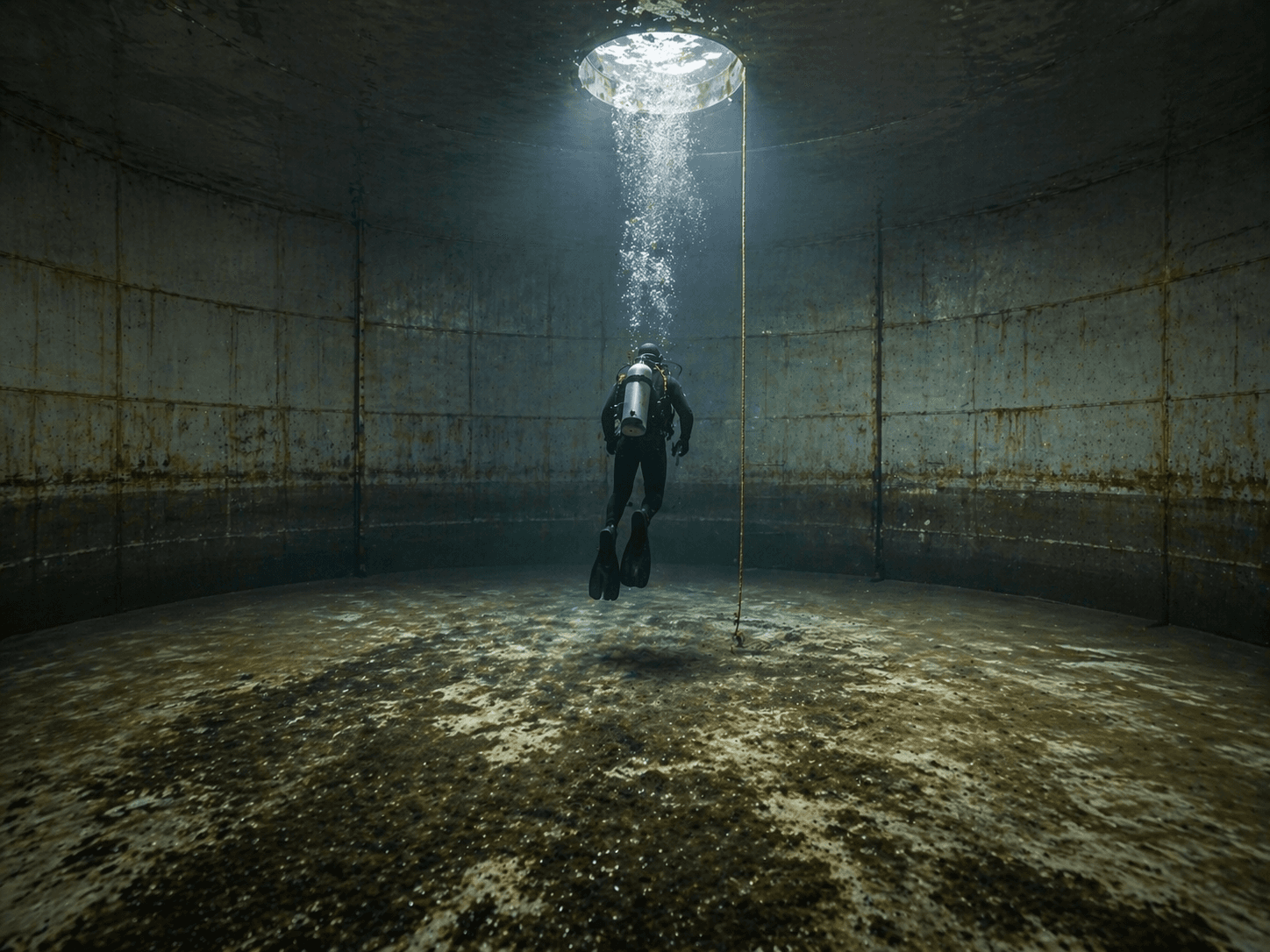
Most people have never thought about how a water tank gets cleaned. The answer might surprise you: a specialist diver goes in while the tank is still full — and your taps keep running the whole time.
This is diver vacuuming — the method that replaced the old drain-and-sweep approach and became the standard for potable water storage tank cleaning in Australia. No service disruption. No confined-space entry for the crew outside. And critically, the tank stays online.
The diver works in a dry suit and full-face mask — not for their safety, but for the water's. This is probably the only type of diving where the water is more at risk from the diver than the diver is from the environment. Every piece of equipment that enters a potable tank is dedicated to that tank, disinfected, and strictly controlled.
The pump primes over the top when the tank is at least 80% capacity. Deeper tanks can be partially reduced using a scour plug method instead.
Every tank has a different internal layout — posts, pipework, ladder platforms. A systematic pattern ensures no sediment is left in the hard-to-reach zones.
Three vacuum head sizes handle different sediment types — sticky, loose, and fine. Sediment exits via hose to a settling tank outside. It never re-enters the supply.
The few hours onsite are often the only human contact a storage tank receives in its operational life. Cleaning and condition assessment happen in one visit.
Keep sediment loadings small — 5 to 15mm — and everything becomes more manageable: disposal, disinfection, water quality. Let it build, and every job downstream gets harder and more expensive.
Diver vacuuming allows a water storage tank to be cleaned without taking it offline. A specialist diver enters the full tank in a dry suit and full-face mask — using dedicated, disinfected equipment — and removes sediment via a vacuum system that exits the tank without re-entering the water supply. Keeping sediment loads below 15mm is the difference between a routine clean and an emergency remediation.
What is diver vacuuming in water tank cleaning?
Diver vacuuming is the standard method for cleaning potable water storage tanks in Australia. A specialist diver enters the tank in a dry suit and full-face mask, using a vacuum system to remove sediment from the floor while the tank remains full and in service. Water supply is not interrupted at any point during the process.
Can a water storage tank be cleaned while it is still in service?
Yes. Diver vacuuming is specifically designed for in-service cleaning. The tank stays online and water supply continues uninterrupted throughout the entire process. This makes it the preferred method for utilities and councils who cannot afford service disruption.
How often should a potable water storage tank be cleaned?
Cleaning intervals depend on water source and tank type. Clear water storage at a treatment plant typically requires cleaning every 6–12 months. Standard distribution tanks range from 4–6 years. Bore water tanks with high iron or manganese content should be cleaned every 2–4 years to prevent sediment from becoming a water quality problem.
How long does it take to clean a water storage tank?
Duration depends on tank size, internal geometry, and sediment load. A straightforward mid-sized reservoir may take 4–8 hours on site. Tanks with significant sediment accumulation, complex internal layouts, or restricted hatch access may require a return visit. Keeping sediment levels below 15mm between cleans significantly reduces time and cost per visit.
What is the difference between a water tank inspection and a water tank clean?
Cleaning removes physical contamination — sediment, silt, and biological matter — from the tank interior. An inspection assesses the structural and surface condition: wall coatings, roof structure, access hardware, and compliance status under relevant Australian Standards. Both can often be combined in a single site visit, which reduces overall cost and disruption.
PC Water Infrastructure provides potable water tank cleaning and condition assessment across Australia, including diver vacuuming, ROV inspection, and combined clean-and-assess site visits.
Book a tank clean