
Bendigo grew rapidly on gold in a naturally dry central Victorian climate, and water security has been a defining regional theme from the goldfields era through to today's reservoir and pipeline network. That history is a useful lens for how tank storage should be planned in the region now.
Reservoir dependence in a naturally dry climate
Bendigo's water supply relies significantly on reservoir storage, including systems like Lake Eppalock, in a region with lower and more variable rainfall than much of coastal Victoria — meaning the reliability of that reservoir-fed supply during extended dry periods is a genuine, historically demonstrated concern, not a hypothetical risk.
Growth pressure on existing supply
As a significant and growing regional centre, Bendigo's expanding population and commercial base place additional demand on a water supply system that already has to manage genuine climate variability — a combination that makes property-level water security planning, including appropriately sized tank storage, a sensible complement to network reliance rather than an unnecessary redundancy.

For a property or business in greater Bendigo, this generally means treating water storage sizing as a genuine planning exercise against realistic dry-period demand, rather than an afterthought, and keeping any existing tank's condition and capacity verified through regular inspection so it can actually contribute meaningfully during a period of network stress.
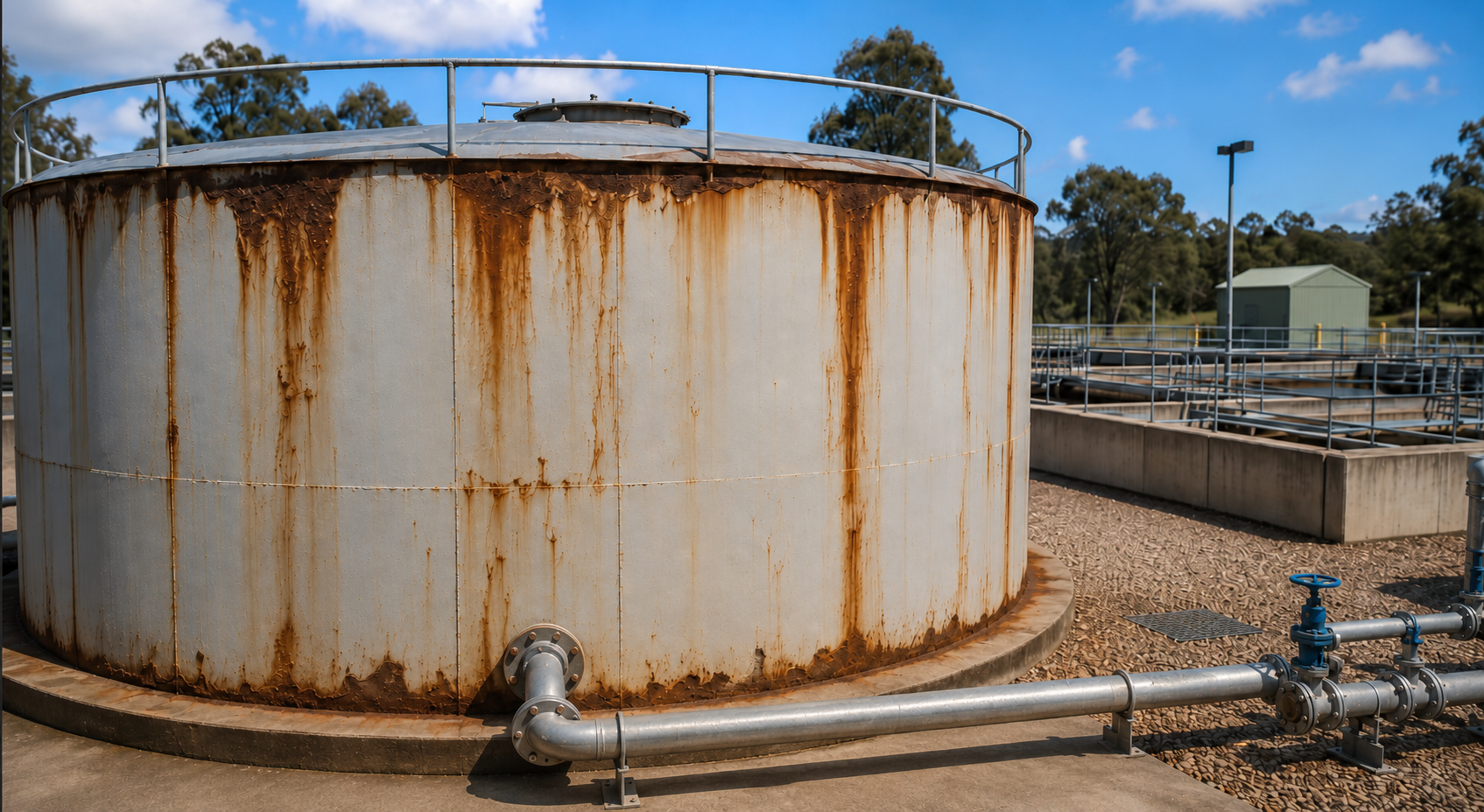
Bendigo's history is a long-running case study in taking water scarcity seriously as a planning input. That same discipline, applied at the individual property level, is what makes tank storage a genuine asset rather than an assumption.
| Check | Why it matters locally |
|---|---|
| Storage sized against realistic dry-period demand for the region | The area's climate variability makes this a genuine, not theoretical, planning input |
| Regular condition inspection to verify actual capacity | A tank's rated capacity only helps if it is confirmed reliable through inspection |
| Fire compliance volume protected from general use | Particularly important as regional demand grows alongside population |
| Consideration of storage as a complement to, not replacement for, network supply | Property-level storage adds resilience without needing to fully replace reticulated supply |
Does Bendigo's growth affect how much water storage a property should have?
Growth increasing demand on a shared regional supply system is a reasonable factor to weigh when deciding how much property-level storage makes sense as a complement to network reliance, particularly for businesses where supply continuity matters operationally.
Is Bendigo's climate genuinely drier than much of Victoria?
Central Victoria, including the Bendigo region, generally experiences lower and more variable rainfall than coastal parts of the state, which is a relevant factor in regional water security planning at both the reservoir and property level.
Should an existing tank in the Bendigo region be inspected more often given the local climate?
A standard, well-maintained inspection schedule is generally appropriate regardless of climate, but for properties that treat tank storage as a meaningful contingency during dry periods, confirming that inspection schedule is actually being followed is particularly worthwhile.
Planning or maintaining water storage for a Bendigo region property? A properly sized, verified tank complements the region's broader water security approach.
Discuss your Bendigo region project