

Few Australian regions have a water security story as remarkable as Kalgoorlie's — a goldfields city sustained for well over a century by a pipeline carrying water hundreds of kilometres from a coastal catchment near Perth. That history reflects just how seriously water security has always had to be taken in this arid, remote mining region.
An arid climate with no reliable local surface water
The Eastern Goldfields region around Kalgoorlie has never had a reliable local surface water source capable of sustaining a city and its mining industry — which is precisely why the historic pipeline scheme was built, and why water security in the region has always required deliberate infrastructure investment rather than reliance on natural local supply.
Mining industry water demand at scale
Kalgoorlie's ongoing mining and resources activity places substantial water demand on the region, with process, dust suppression and potable water needs all drawn from the same constrained regional supply context — consistent with the broader challenge mining and resources operations face around water storage compliance and cross-system separation.

For a mining, industrial or commercial facility in the Kalgoorlie region, this generally means treating on-site water storage with the same seriousness the region's broader supply history demonstrates — properly separated potable, process and dust suppression systems to avoid cross-connection risk, storage sized against the area's genuine remote-supply constraints, and maintenance planning that accounts for extreme heat and arid conditions accelerating wear on exposed fittings and coatings.
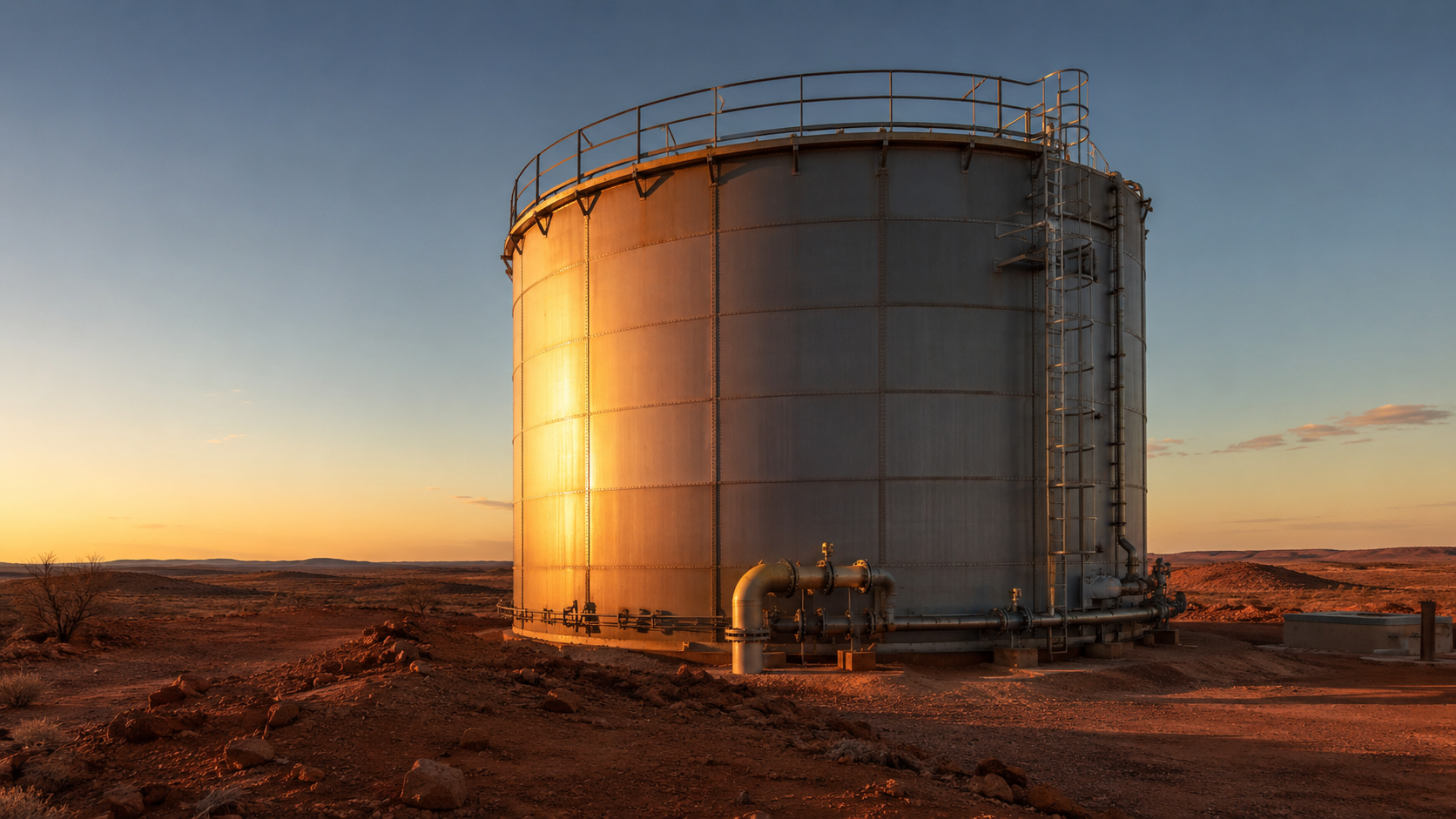
A region that has depended on water piped hundreds of kilometres for over a century does not take water security lightly. On-site storage and system separation at any Kalgoorlie facility deserve the same rigour.
| Check | Why it matters locally |
|---|---|
| Separation between potable, process and dust suppression systems | Prevents cross-connection risk across multiple parallel water uses |
| Storage sized against the region's genuine remote-supply constraints | Reflects the area's long-standing, well-documented water security context |
| Coating and fitting condition under extreme heat and arid conditions | Accelerated wear is common and worth a more frequent inspection cycle |
| Site-specific licence conditions for mining operations | Often extend beyond general Australian Standards for water storage |
Why does Kalgoorlie's water supply history matter for a modern facility's water storage planning?
It illustrates just how constrained the region's natural water supply genuinely is, which is a useful reminder to treat on-site storage, separation between systems, and sizing with real seriousness rather than assuming the kind of supply reliability more common in coastal or better-watered regions.
Does the arid Kalgoorlie climate affect tank maintenance frequency?
Extreme heat and arid conditions can accelerate coating and fitting wear, which is a reasonable basis for a more frequent inspection cycle than a standard temperate-climate default, particularly for external and exposed components.
Do mining operations in the Kalgoorlie region need to separate potable and process water storage?
Yes, generally — mining sites typically run multiple parallel water systems for potable, process and dust suppression use, and proper separation between them is an important compliance and safety consideration, consistent with broader mining sector water storage requirements.
Managing water storage for a mining or industrial facility in the Kalgoorlie region? Separation, sizing and maintenance all deserve attention given the region's genuine water security context.
Discuss your Kalgoorlie region project