
A mine site's water storage compliance obligations do not stop at AS2304 or AS4020. Site-specific licence conditions, process water separation requirements, and regulator reporting sit on top of the standard framework — and treating a mining site's tanks like a standard commercial installation misses that layer entirely.
Process water and potable water must stay genuinely separate
Mine sites frequently operate multiple water systems — potable, process, dust suppression, fire — often supplied from different sources with very different quality requirements. Cross-connection risk between these systems is a specific compliance and safety concern that a standard commercial or residential tank installation rarely has to consider, and it needs to be actively designed against, not assumed away.
Site-specific environmental licence conditions
Most mining operations hold an environmental authority or licence with conditions specific to that site — often including water storage, containment and discharge requirements that go beyond generic Australian Standards. Compliance on a mine site means meeting the licence conditions specifically, not just the general standard.
Regulator reporting obligations
Water storage and quality data on a mining site is frequently subject to reporting obligations to state mining or environmental regulators — obligations that a standard commercial tank owner simply does not have. Tank monitoring and record-keeping needs to be structured to support that reporting, not bolted on afterward.

Many mining and resources sites are also remote, which means the harsh-environment factors — extreme temperature swings, dust ingress, limited access for maintenance — sit on top of the compliance obligations rather than replacing them. A tank that meets AS2304 on paper still needs to be maintainable under those site conditions to actually stay compliant over its service life, not just at commissioning.
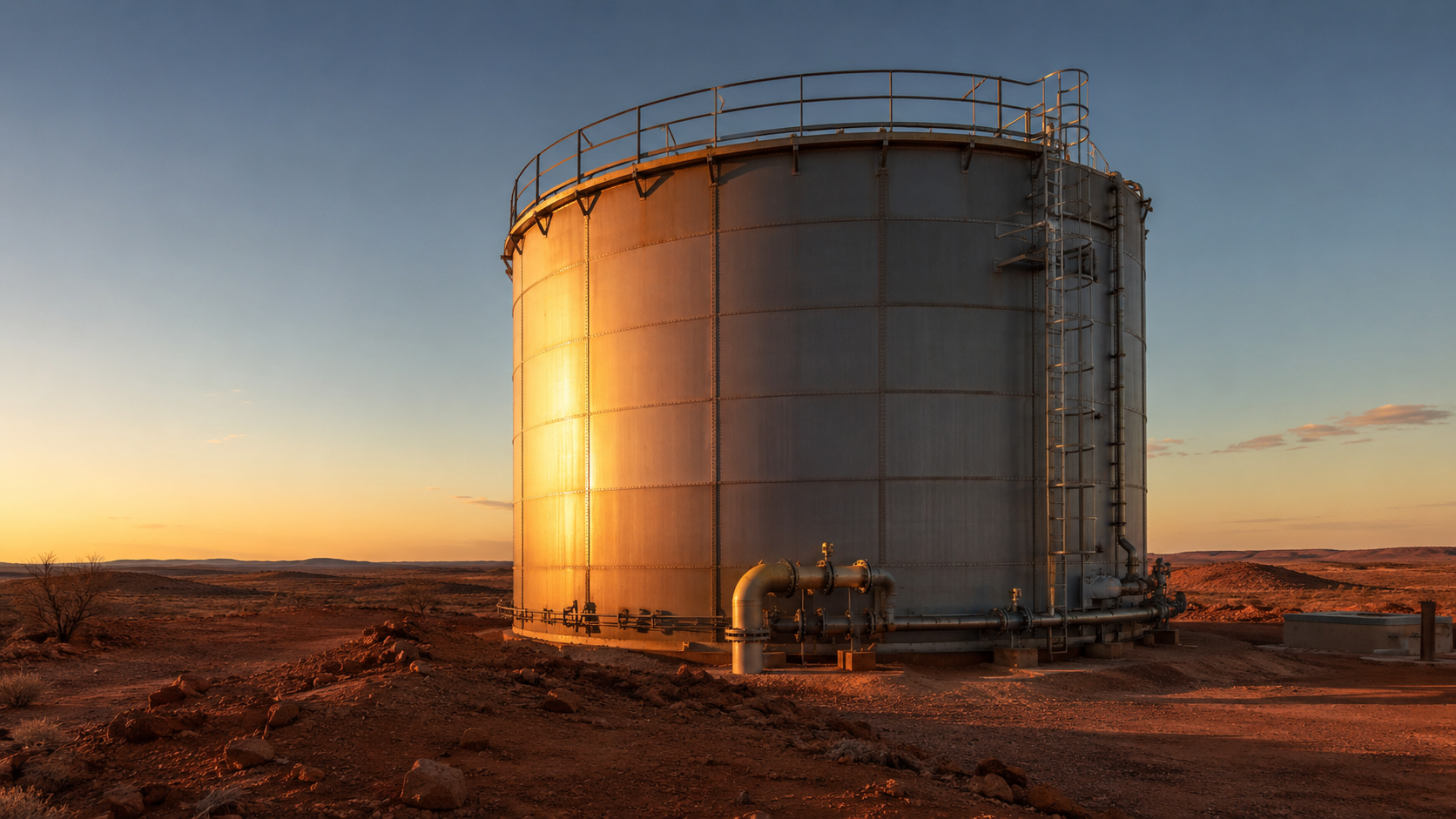
Mining water compliance is not a stricter version of standard tank compliance — it is an additional layer, built on licence conditions and reporting obligations that are specific to that site and that mine's approvals. Assuming the standard framework covers it is how gaps get missed.
| Check | Why it matters |
|---|---|
| Cross-connection risk between potable, process and other systems | A safety and compliance risk specific to multi-system mining sites |
| Site environmental licence conditions for water storage | Often more specific and stringent than general Australian Standards |
| Regulator reporting requirements for water quality and storage | Determines what monitoring and record-keeping the site must maintain |
| Maintenance access under real site conditions | Compliance depends on the tank remaining maintainable over its service life |
| Water source separation and containment design | Prevents contamination between systems with very different quality needs |
Is AS2304 or AS4020 compliance enough for a mine site's water storage?
It is a necessary baseline, but usually not sufficient on its own. Most mining operations carry site-specific environmental licence conditions and regulator reporting obligations that sit on top of the general Australian Standards, and these need to be confirmed and designed for separately.
Why is cross-connection risk a bigger issue on mining sites?
Because mine sites typically operate several parallel water systems — potable, process, dust suppression, fire — often from different sources and with different quality requirements. The more systems on one site, the more points at which an accidental cross-connection could contaminate a system that needs to remain protected.
Who is responsible for confirming licence conditions are being met for water storage?
Ultimately the site operator, but the water infrastructure design and maintenance program should be built to actively support those licence conditions rather than assuming a standard installation will automatically satisfy them. This is best confirmed at design stage, working from the site's actual licence documentation.
Managing water storage compliance on a mining or resources site? We work to the site-specific requirements, not just the general standard.
Discuss your site's compliance requirements