
Toowoomba's relationship with water security is not abstract — a serious water shortage in the mid-2000s reshaped how the city and the wider Darling Downs region think about storage, supply and redundancy. That history still shapes what "adequate" water storage looks like for a property or business in the region today.
An elevated inland city on the Great Dividing Range
Sitting on the Great Dividing Range escarpment, Toowoomba does not have the large river system many regional cities rely on, which historically pushed the city toward diversified supply — recycled water, pipeline connections, and, for many rural and semi-rural properties on the Downs, a genuine reliance on tank storage as a primary or supplementary source rather than a backup.
Agricultural demand on the Downs
The Darling Downs is one of Australia's most significant agricultural regions, and farm and agribusiness water storage on the Downs carries its own sizing and compliance considerations — different from an urban commercial tank, and often larger in scale, with bore water quality and seasonal demand variation as real factors in tank specification.

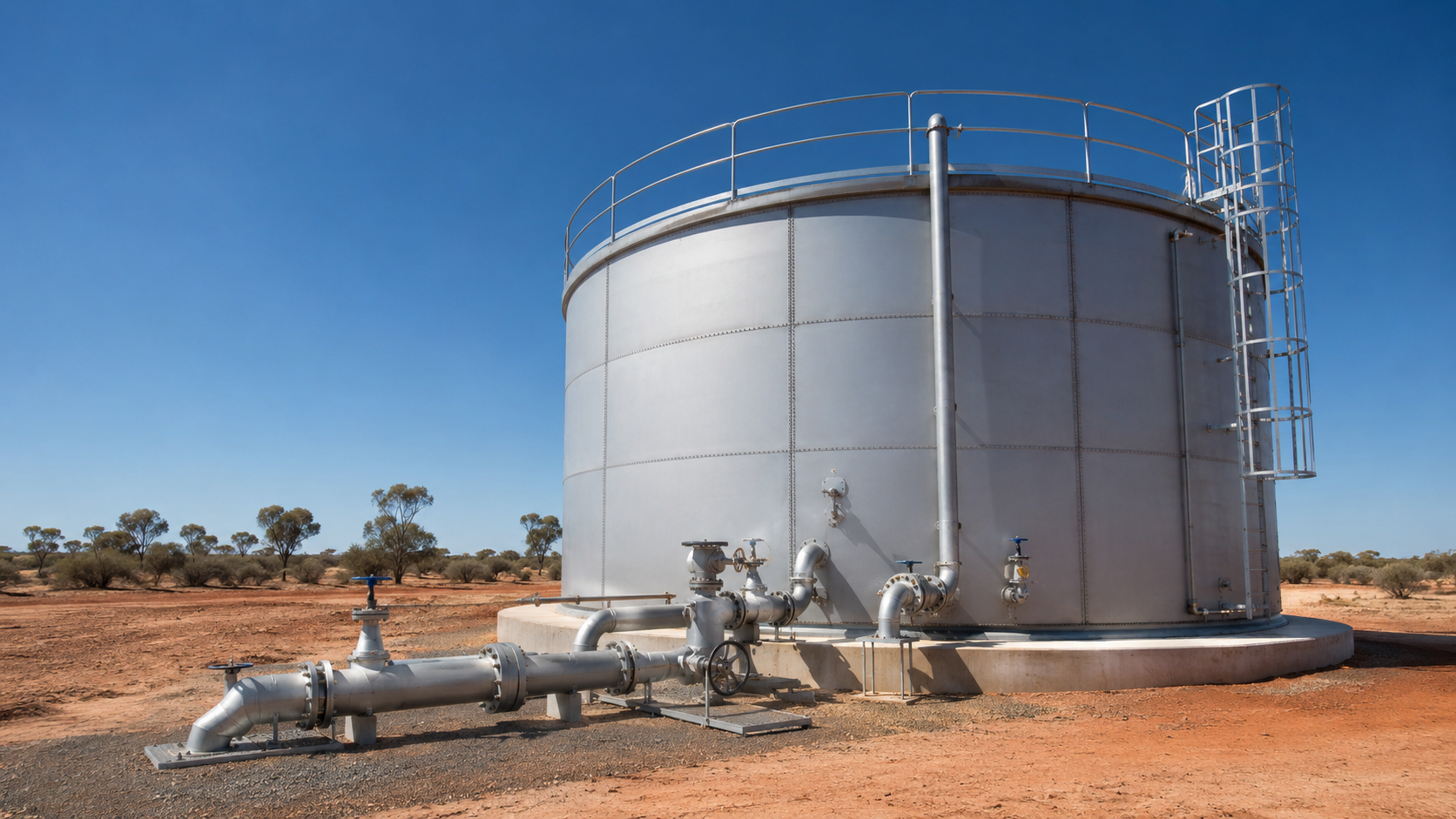
For a Darling Downs property — agricultural, commercial or industrial — the practical takeaway is that water storage deserves the same rigour a metro property might apply to a networked backup, because for many sites on the Downs, the tank genuinely is the primary contingency. That means proper sizing against realistic demand and dry-period duration, a maintained inspection schedule so the tank actually delivers its rated capacity when drawn down hard, and fire compliance storage that is not quietly competing with agricultural or domestic draw from the same source.
A region that has already lived through a genuine water shortage does not need convincing that storage matters. What it needs is storage sized, maintained and inspected to actually perform when the dry period tests it again.
| Check | Why it matters locally |
|---|---|
| Tank sizing against realistic dry-period duration | The region's water security history makes this a genuine, not theoretical, planning factor |
| Separation of fire compliance volume from agricultural/domestic draw | Shared storage without a reserved volume can leave fire compliance short |
| Bore water quality effects on tank internals | Common regional water chemistry can accelerate certain corrosion or scaling patterns |
| Condition inspection on schedule, not deferred | A tank the property depends on as primary supply needs verified, not assumed, capacity |
Do Darling Downs properties typically need larger water storage than a comparable metro site?
Often yes, particularly for agricultural and semi-rural properties where tank storage is a primary rather than backup source. Sizing should be based on realistic dry-period duration and actual demand for the specific property, not a standard metro assumption.
Does bore water common in the region affect tank material or coating choice?
It can — bore water chemistry varies by location and can influence corrosion or scaling behaviour, which is worth factoring into material and coating specification for a new tank or when planning maintenance on an existing one.
Is fire compliance storage often shared with general property water use on the Downs?
It can be on some existing properties, but this is a compliance risk if the fire volume is not properly reserved and protected from everyday drawdown. A dedicated, reserved fire volume is the safer and generally required approach.
Servicing a property or facility on the Darling Downs? We work across the region on tank inspection, maintenance and new installations sized for its specific water security context.
Discuss your Toowoomba region project