

A tank failure rarely happens at a convenient time, and the pressure to keep supply running can push toward a quick fix before the actual severity of the problem has been properly assessed. Some situations genuinely can be safely bridged with a temporary measure. Others cannot, and treating them the same way is how a manageable incident becomes a much bigger one.
Minor, localised leaks with confirmed structural integrity
A small, localised leak — a failed seal at a fitting, a minor coating breach with no significant metal loss — can often be safely managed with an appropriate temporary patch or clamp while a proper repair is scheduled, provided the surrounding structure has been checked and is not compromised.
Non-critical, redundant assets
Where a failed tank is one of several redundant storage or supply paths, and its failure does not immediately compromise supply continuity or fire compliance, taking it offline entirely while a proper repair is planned is often the safer and more appropriate response than attempting any interim fix under pressure.

Structural integrity concerns
Any indication of genuine structural compromise — significant metal loss, cracking that suggests active failure, or a leak whose extent cannot be quickly and confidently assessed — should not be patched and left in service. The consequence of a structural failure escalating while under a temporary fix is far more serious than the cost of a planned shutdown.
Fire compliance tanks with no redundancy
A sole fire water supply tank experiencing a significant failure needs immediate, careful assessment — a temporary measure that does not restore full confidence in the tank's ability to deliver its required volume on demand should not be treated as resolving the compliance gap, even if it stops an active leak.
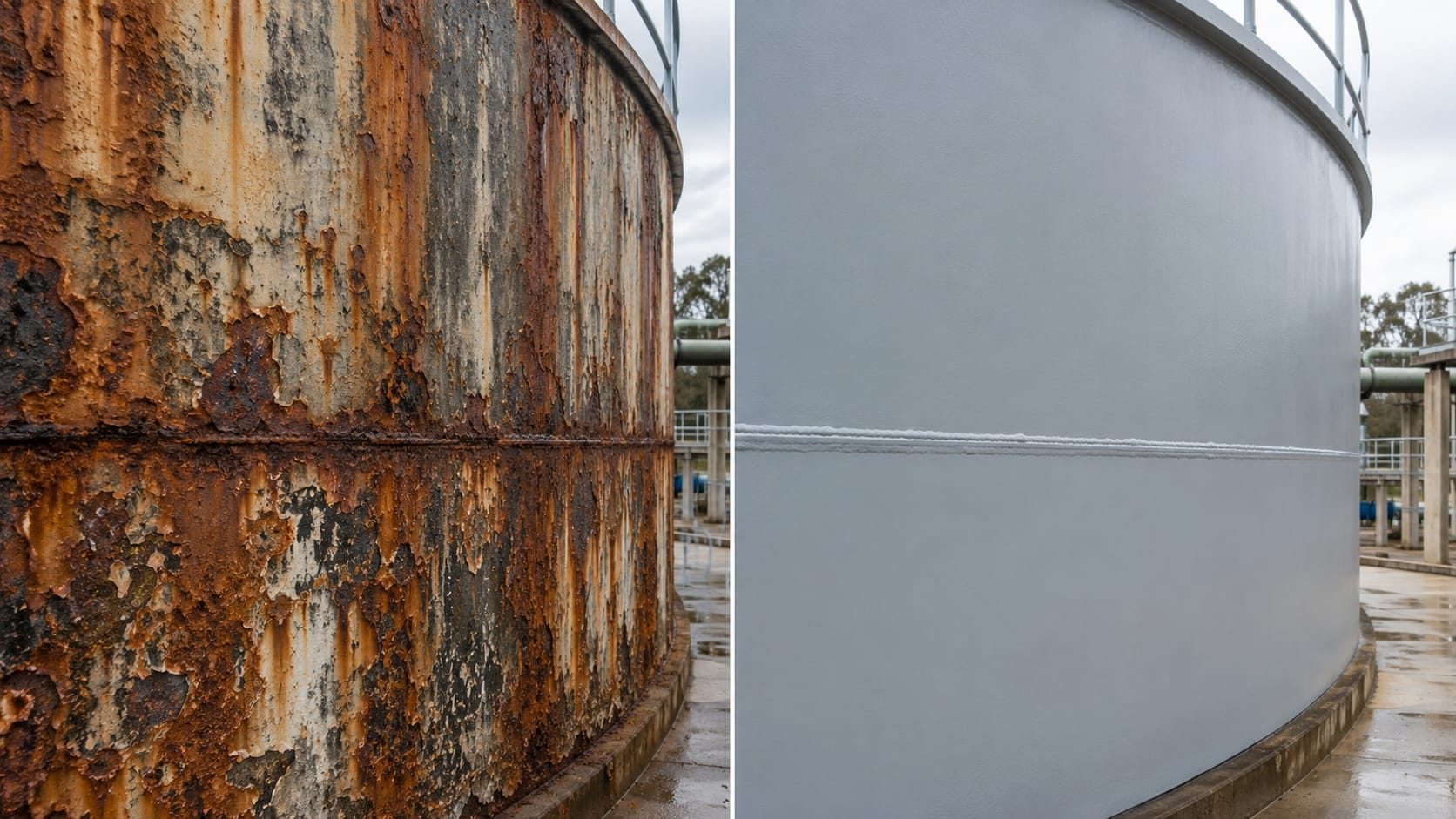
The question during an emergency is never just "can this be patched." It is "does this patch restore genuine structural and functional confidence, or does it just hide the problem while the underlying risk continues." Those are very different outcomes wearing the same temporary fix.
| Question | What it determines |
|---|---|
| Is the surrounding structure confirmed sound? | A temporary patch is only appropriate if the broader structure is not compromised |
| Is this a sole or redundant supply/compliance asset? | Determines whether shutdown is a viable immediate option |
| Can the failure's extent be confidently assessed quickly? | An unclear extent should default to caution, not assumption |
| Does a temporary fix restore genuine functional confidence? | A fix that hides symptoms without addressing risk is not a real solution |
| Is a proper repair scheduled with a defined timeframe? | A temporary measure should always have a planned end date, not become permanent |
Can a leaking water tank be patched and left in service until a proper repair can be scheduled?
Sometimes, if the leak is minor and localised and the surrounding structure has been confirmed sound — but this should be a deliberate assessment, not an assumption. Any doubt about structural integrity or the true extent of the problem should default to a more cautious response, including shutdown if necessary.
What should happen first when a tank failure is discovered?
A prompt but genuine assessment of the failure's extent and the surrounding structural condition, before any repair decision is made — rushing straight to a fix without this assessment risks either under-reacting to a serious problem or over-reacting to a minor one.
Is it acceptable to leave a temporary fix in place indefinitely if it seems to be working?
No — a temporary fix should always be paired with a scheduled, proper repair within a defined timeframe. A temporary measure that quietly becomes permanent because it "seems fine" is a common way an underlying risk goes unaddressed for far longer than intended.
Dealing with an unexpected tank failure? A fast, accurate assessment is the difference between a safe temporary bridge and a compounding risk.
Request emergency assessment support