
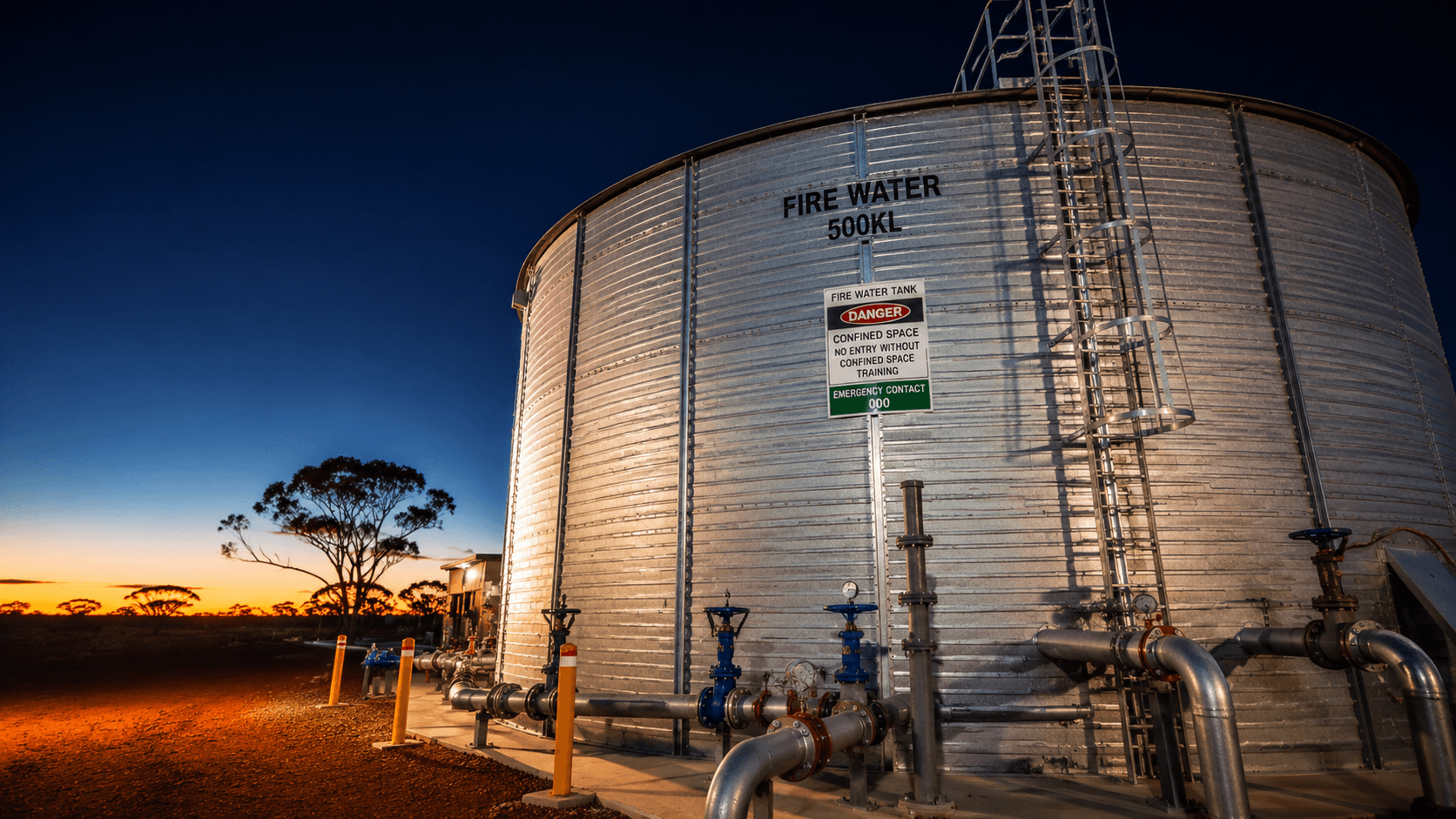
Having a water tank on a bushfire-prone property is not the same as having a compliant static water supply. Fire authorities specify minimum volume, fitting types and accessibility requirements precisely because a tank that cannot be reliably accessed and drawn from under fire conditions provides false confidence, not real protection.
Minimum dedicated volume
Building and planning requirements for bushfire-prone areas typically specify a minimum volume of water that must be available specifically for firefighting purposes — separate from, or a defined reserved portion of, any general household or stock water storage. A tank that is regularly drawn down for domestic use below that reserved level does not meet the intent of the requirement even if its nameplate capacity looks adequate on paper.
Fire brigade-compatible fittings
The outlet needs a fitting compatible with the fire service's equipment — typically a specified coupling type and size positioned for a pump to connect and draw water under emergency conditions, not a standard domestic tap or garden fitting that firefighting equipment cannot connect to.
All-weather access for a fire appliance
The tank needs to be positioned and the surrounding access maintained so that a fire appliance can reach it and draw water even under the access-degrading conditions a bushfire event itself can create — overgrown vegetation, damaged fencing, or approach tracks that are only ever tested when it is too late to fix them.
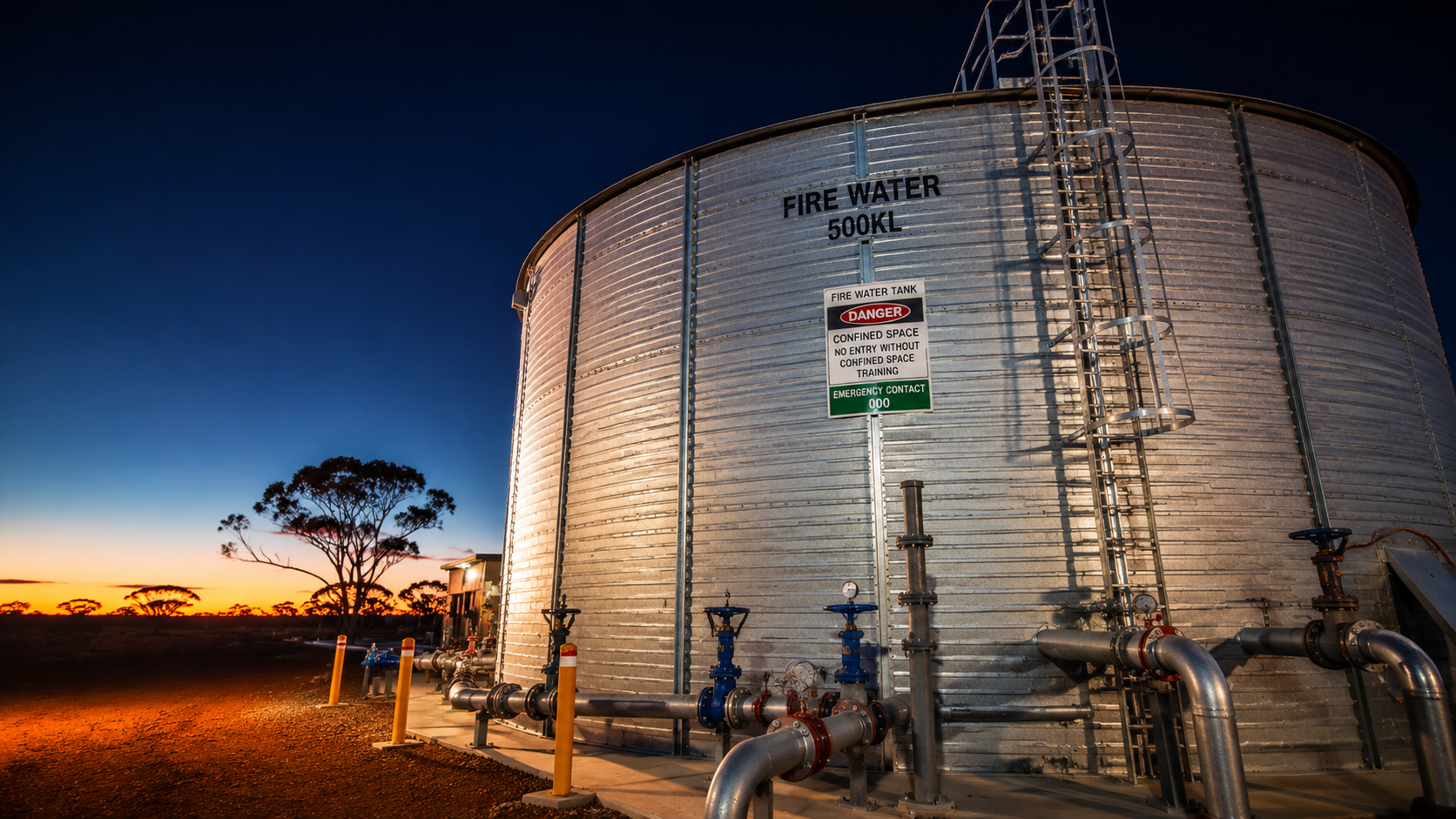
Many rural and bushfire-prone properties already have substantial water storage for domestic or stock purposes — and property owners reasonably assume that storage doubles as bushfire protection. Without the reserved volume, correct fitting and maintained access specifically confirmed, that assumption is often wrong, and it is precisely the assumption that gets tested during an actual fire event rather than during a routine check.

A static water supply is only as good as the moment it is actually needed — which is the worst possible time to discover the fitting is wrong, the access is blocked, or the reserved volume was quietly drawn down months ago.
| Check | Why it matters |
|---|---|
| Reserved firefighting volume confirmed and protected from domestic drawdown | The tank must actually hold the required volume when needed, not on paper only |
| Correct fire brigade coupling fitted and accessible | Fire appliances cannot draw water through an incompatible fitting |
| Clear, maintained access for a fire appliance | Access can degrade in exactly the conditions that make the supply necessary |
| Tank structural and coating condition inspected | A failing tank may not hold its rated volume when it matters most |
| Signage identifying the static water supply location | Helps fire crews locate the supply quickly under pressure |
Can my existing rainwater tank be used as a bushfire static water supply?
Potentially, but it needs to meet the specific requirements — reserved volume, correct fire brigade fitting and appliance access — rather than simply being assumed adequate because it holds water. A compliance check against your local fire authority's requirements will confirm what, if anything, needs to change.
How much water is typically required for a bushfire static water supply?
Requirements vary by state, local council and the property's specific bushfire risk rating, so the figure needs to be confirmed against the applicable planning and building requirements for your property rather than assumed from a general rule of thumb.
Who checks that a static water supply is actually compliant?
This is typically confirmed at building approval stage for new developments, but existing properties benefit from a periodic compliance check, particularly if the tank's condition, fittings or site access have changed since it was last assessed.
Not certain your property's water storage meets bushfire static water supply requirements? A compliance check will confirm exactly what's needed.
Request a static water supply assessment