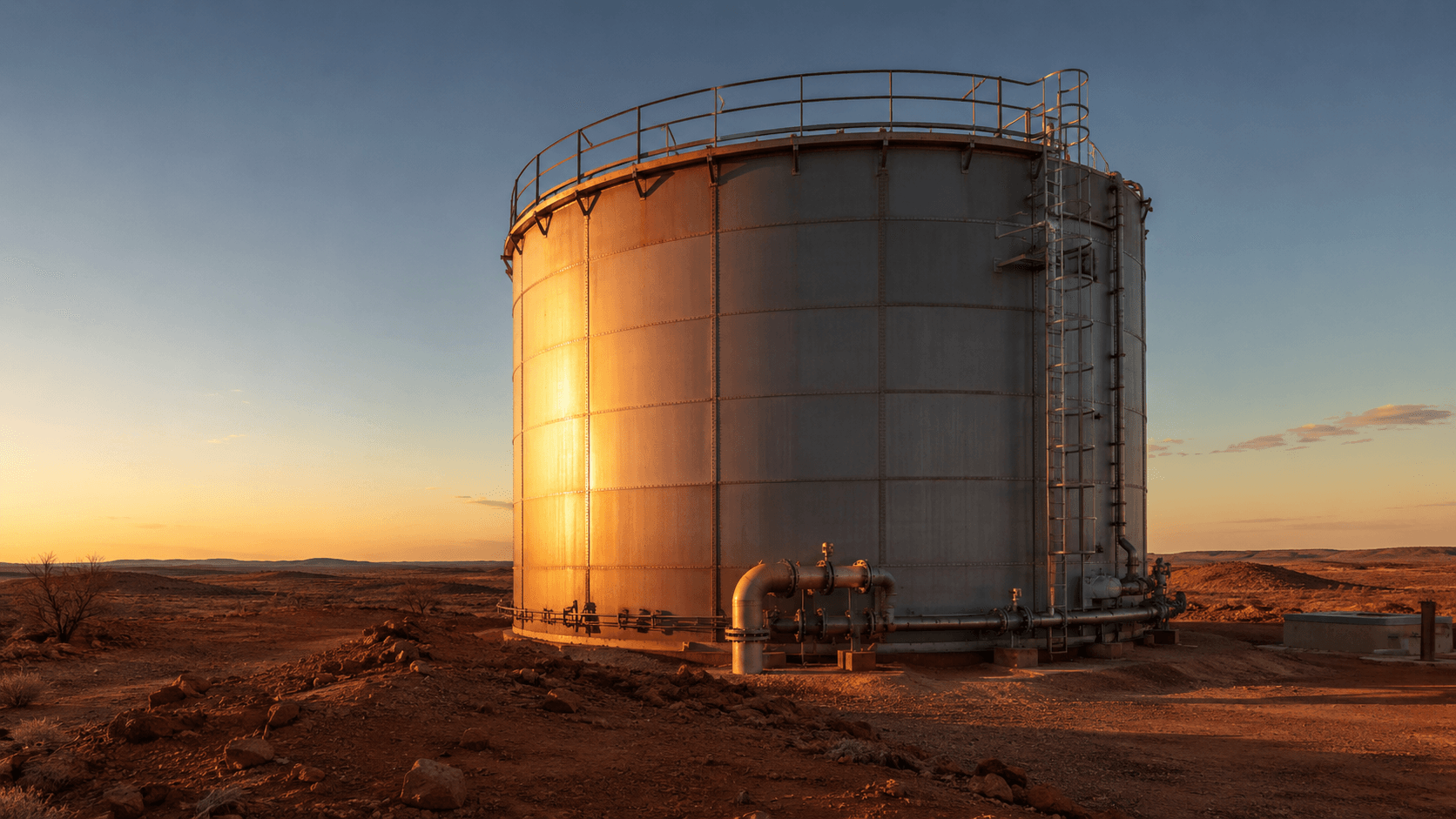
A remote mine site typically has no mains network to fall back on if bulk water storage runs short. Whatever is in the tanks on site, plus whatever a bore field, dam or trucked supply can replenish, is the entire buffer the operation has against a supply interruption.
Bulk water demand on a mine site is rarely a single number. Process water for the plant, dust suppression across haul roads and stockpiles, potable supply for workforce accommodation, and fire protection storage all draw from different parts of the system, on different schedules, with very different consequences if any one of them runs dry.
Process water storage sized against plant throughput, not average demand
Process water demand tracks mill throughput, and throughput is rarely perfectly steady - planned maintenance, ore hardness variation and circuit upsets all change draw from hour to hour. Storage sized only to the average daily demand figure leaves no buffer for these swings, and a plant that runs short of process water even briefly can lose far more in downtime than the storage capacity would have cost.
Potable and amenity supply needs its own dedicated buffer
Workforce accommodation potable supply should not share a single undifferentiated storage pool with process water, both for water quality reasons and because a process water shortfall should never be allowed to compromise drinking water security for site personnel. Separating these categories, with potable storage sized against workforce numbers rather than process demand, is standard practice on well-run sites.
Storage capacity offsets supply source unreliability
A bore field yield can vary seasonally, a dam can draw down through a dry period, and trucked water delivery is constrained by road access and truck availability. The less reliable and more variable the supply source, the more storage buffer a site needs to carry to avoid a genuine shortfall - this relationship is one of the more important sizing inputs and one of the easiest to underestimate at the design stage.
Redundancy across multiple storage points, not one large tank
Splitting bulk storage across several tanks rather than concentrating it in a single large vessel means a tank taken offline for maintenance or repair does not remove the site entire storage buffer at once. This is a straightforward resilience principle that is often traded away for capital cost savings early in a project, then regretted later.
Bulk water storage sizing on a remote mine site is a risk management decision as much as an engineering calculation - the real question is how much of a supply interruption the operation can absorb before it becomes a production problem.
| Factor | What it drives |
|---|---|
| Plant throughput variability | Sets process water storage buffer above the average demand figure |
| Workforce accommodation numbers | Sizes a dedicated, separate potable storage allocation |
| Supply source reliability | Less reliable sources need a larger storage buffer to compensate |
| Number of storage points | Splitting capacity avoids a single point of failure during maintenance |
How is bulk water storage sized for a remote mine site?
By assessing each demand category separately - process, dust suppression, potable and fire - against the reliability of the supply source, then sizing a buffer that can absorb realistic supply interruptions and demand swings for each.
Should process and potable water share the same storage tanks?
Generally no. Separating potable supply into its own dedicated storage protects drinking water quality and ensures a process water shortfall cannot compromise workforce water security.
Why split bulk storage across multiple tanks instead of one large tank?
A single large tank taken offline for maintenance or repair removes the entire storage buffer at once. Multiple smaller storage points allow one tank to be serviced while the others maintain supply.
Planning bulk water storage for a remote mine site? PC Water Infrastructure sizes and delivers storage solutions built for genuinely remote operations.
Discuss Remote Site Water Storage