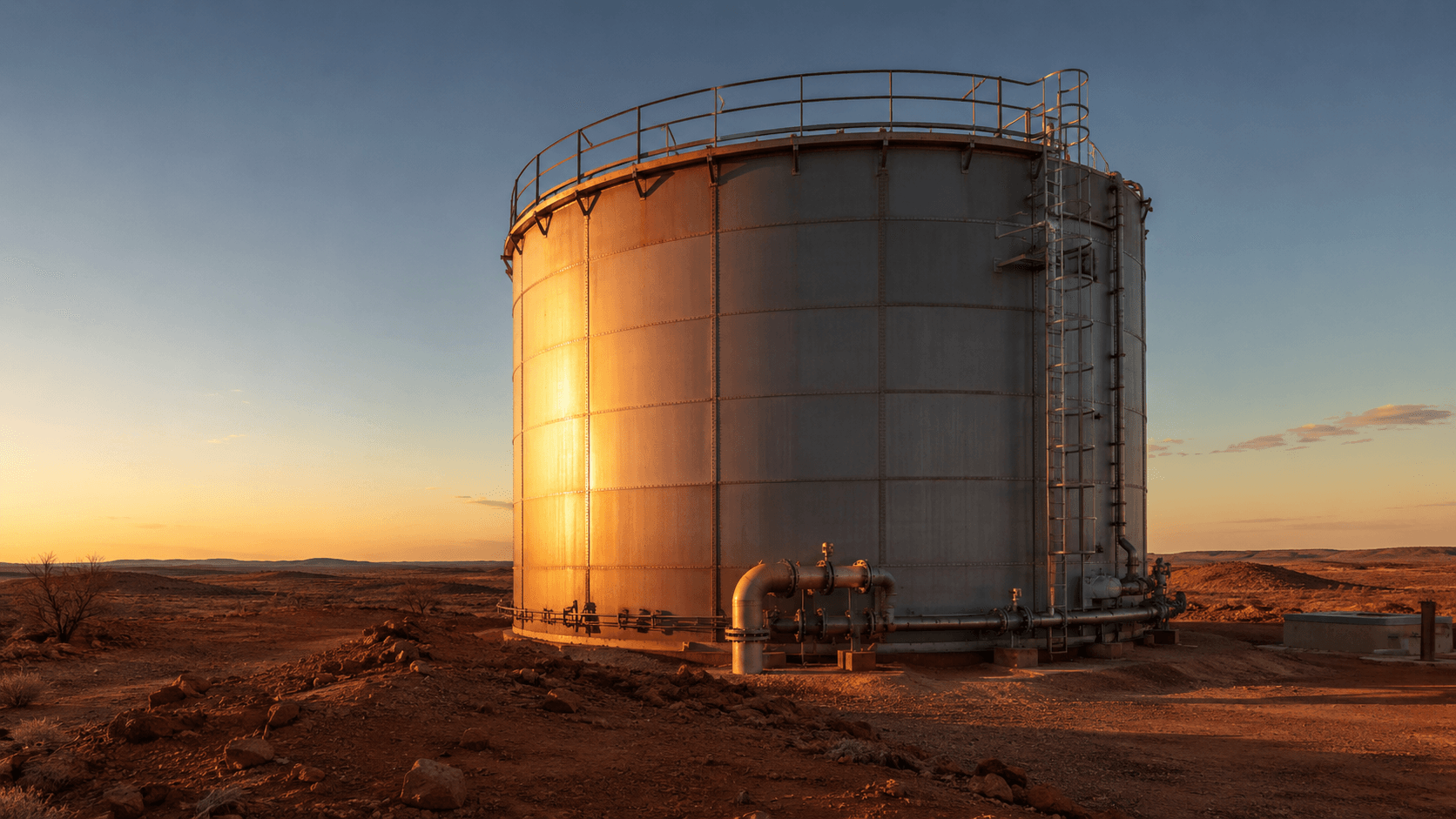
A mains-powered pump can, within reason, run whenever demand requires it. A solar-pumped system cannot — it can only pump when the sun is providing enough output, which means storage is not just buffering demand fluctuation, it is buffering the entire supply side of the system.
This changes the sizing logic in a way that catches out designs carried over from mains-powered assumptions. A tank sized purely on daily demand, without accounting for consecutive low-solar days, can leave a remote site without water precisely when supply is already constrained — during extended cloud cover or the shorter daylight hours of winter.
Sizing for consecutive low-output days, not just daily demand
Solar output varies day to day with weather and season, and a robust off-grid design sizes storage to cover a defined number of consecutive low-output days — often referred to as autonomy days — rather than assuming average solar conditions will hold. The right number of autonomy days depends on how critical continuous supply is to the site and how much seasonal solar variation the location actually experiences, which is a site-specific analysis, not a fixed rule.
Pump run-time windows are shorter and less predictable
A solar pump typically operates only during effective daylight hours, and its output curve rises and falls with the sun rather than running at a constant rate. This means the pump has a genuinely limited window each day to refill storage, and system design needs to confirm that window is sufficient to meet the site's actual daily draw — not just that average daily solar generation matches average daily demand on paper.

Panel and pump sizing has to match the storage strategy, not the other way around
It is tempting to size the solar array and pump first and treat storage as whatever fits the budget left over. A more reliable approach sizes storage first based on required autonomy, then sizes the solar array and pump to comfortably refill that storage within the available daylight window — including a margin for below-average solar days, not just the annual average.
Battery-backed pumping is a different system, not a minor upgrade
Adding battery storage to power the pump outside daylight hours changes the system from solar-direct to solar-with-storage, with different sizing, cost and maintenance implications. This can reduce required tank autonomy by smoothing pump operation across more of the day, but it introduces battery maintenance and replacement as a new lifecycle cost that needs to be weighed against the larger-tank alternative.
In a solar-pumped system, the tank is not just meeting demand — it is standing in for the reliability a mains power connection would otherwise provide.
| Check | Why it matters |
|---|---|
| Required autonomy days for the specific site | Storage needs to cover low-solar periods, not just average demand |
| Seasonal daylight hours at the actual location | Winter pumping windows can be substantially shorter than summer |
| Pump output curve across the daylight window | Average daily output can mask an inadequate peak refill rate |
| Elevated vs ground-level storage strategy | Affects reliance on continuous pump operation for delivery pressure |
How much storage does a solar-pumped water system actually need?
More than an equivalent mains-powered system sized on demand alone. Solar systems are typically sized with a defined number of autonomy days to cover consecutive low-solar periods, and the right number depends on site-specific seasonal solar variation and how critical continuous supply is.
Does adding battery storage reduce the required tank size?
It can, by allowing pumping to continue outside daylight hours and smoothing supply across more of the day. However, batteries introduce their own maintenance and replacement lifecycle, so the trade-off between a larger tank and battery-backed pumping should be assessed on total lifecycle cost, not tank size alone.
What happens if a solar water system is undersized for autonomy days?
The site can run out of stored water during extended cloud cover or shorter winter daylight periods, even if average annual solar generation appears adequate on paper. This is why sizing should account for realistic low-output periods, not average conditions.
Planning an off-grid water supply system? PC Water Infrastructure can size storage against realistic solar output for your specific site and region.
Discuss Remote Water Supply