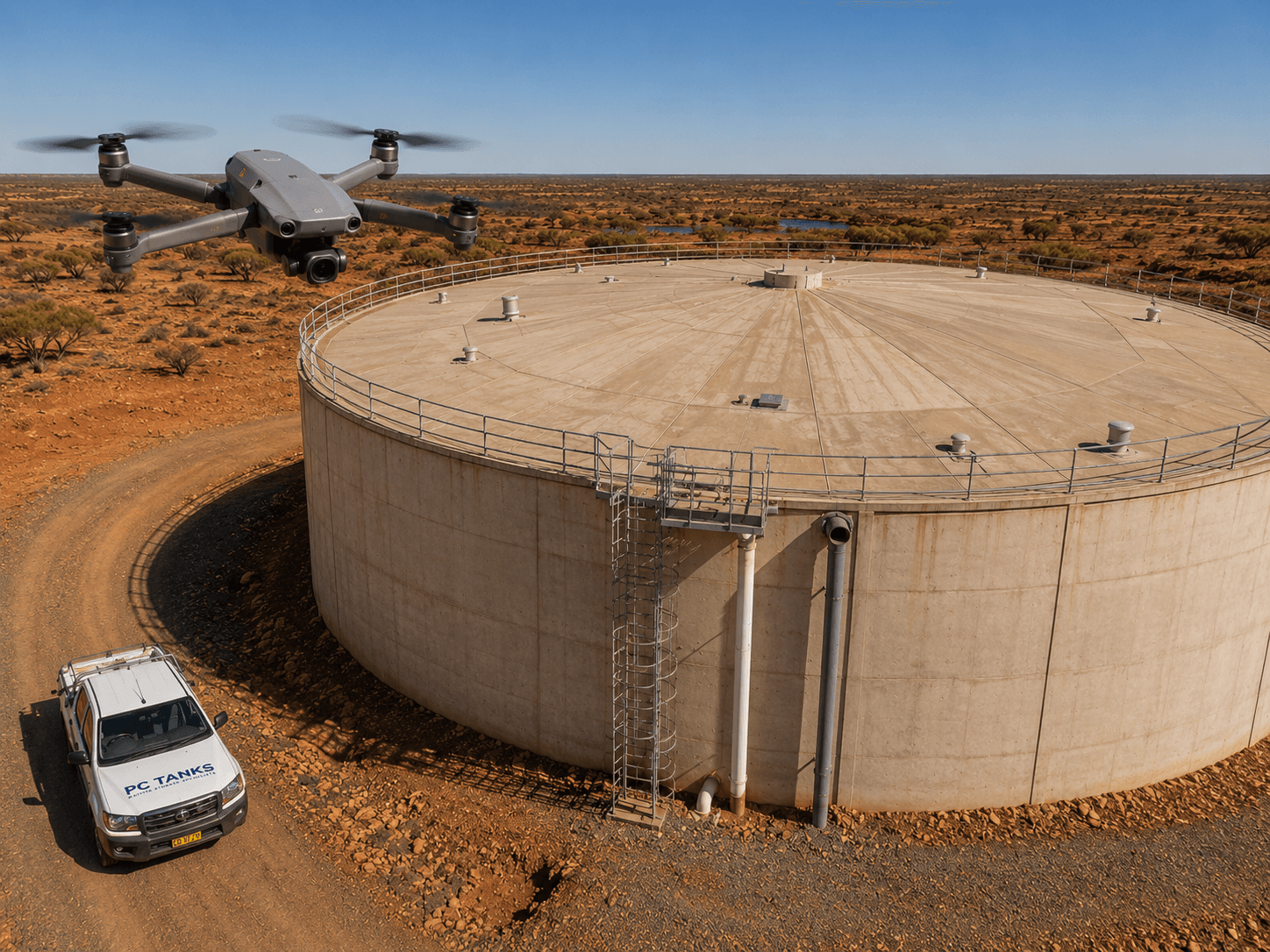
The overflow drain is a critical safeguard — it stops your tank from being overpressured. But for most of the year, the open end sitting in the grass isn't releasing water. It's providing shelter.
One of the most overlooked animal entry pathways sits at ground level, away from the tank, pointing at a paddock: the overflow drain point. The overflow pipe itself is essential — it prevents structural overpressure when a tank reaches capacity, routing excess water to a drain or soakage area. The riser climbs from the tank's high-water mark to an outlet positioned some distance from the tank perimeter. And the drain end? It sits open, waiting for the next overflow event — which, in most potable water systems, might not happen for months.
A dry, dark, sheltered pipe sitting in an Australian paddock is not just infrastructure. To the local wildlife, it's a burrow. A snake smells water. A rabbit follows the scent. A feral cat investigates the opening. The overflow riser runs straight up into the tank interior — and once an animal climbs it, the confined space they find at the top offers no route back.
They drown. The carcass contaminates the stored water. And unless the tank is on a regular inspection cycle, no one knows until the distribution system starts delivering the evidence.
The overflow drain is the most overlooked route. But it's not the only one. Animal entry into water storage tanks happens through four distinct pathways, and in most cases more than one is active at a time.
1. The overflow drain point — An open-ended drain pipe with no valve. Overflow events are rare. Between events, the pipe is dry and hospitable. Rabbits, cats, and snakes are the most common entrants — small enough to fit the pipe diameter, drawn in by the smell of water. A flapper valve eliminates this risk entirely.
2. Vandal-damaged or unsealed access hatches — Vandal activity can leave hatches open or damage locking mechanisms. On inground tanks especially, an open hatch can admit larger animals — possums, goannas, and in rare cases feral foxes. Regular hatch audits are not optional maintenance; they're the line between a secure asset and an exposed one.
3. Deteriorated vent mesh and roof edge flashings — Smaller birds don't require much space. Unsealed roof edge flashings and damaged or poorly installed vent mesh are the primary entry routes for small birds seeking protected nesting areas. Birds can enter freely, nest within the tank, and — when they can't find their way back out — die there. The nesting material alone constitutes a contamination risk.
4. Overhanging trees and surrounding bushland — Proximity to bushland increases the pressure on all of the above. Overhanging trees provide a physical bridge from ground-level habitat to roof-level entry points. Keeping vegetation cut back from the tank perimeter is passive exclusion management.
The overflow drain is designed to release water once or twice a year. For the other 363 days, the open end sitting in the grass isn't managing hydraulic pressure — it's managing shelter demand. A flapper valve resolves both functions. Without one, you're managing only the first.
When our divers go into a tank, animal remains are one of the more common findings — particularly small birds near the roof structure and larger animals on the floor. The presence of remains is a direct indicator of an access failure. And in every case, the evidence trail leads back to one of the four pathways above.
The good news: all four are rectifiable. And the cost of rectification is a fraction of the cost of a confirmed contamination event.
Fit a flapper valve to the overflow drain end. A flapper valve — also called a check valve or duck-bill valve — is a one-way seal that opens under flow pressure during an overflow event and stays closed otherwise. It is the single most cost-effective animal exclusion measure available for an overflow drain point. If your overflow drain ends are open, this is the first thing to address.
Inspect and upgrade vent mesh. Vent mesh deteriorates. Corrosion eats through it; physical damage distorts it; poor installation leaves gaps around the edges. Any mesh with holes, missing sections, or inadequate gauge for the local fauna should be replaced. Fine mesh that keeps insects out will also keep small birds out.
Audit hatch condition and locking. A hatch that can be opened by hand — by a person or a determined large mammal — is not a secure closure. Tamper-resistant latches and proper sealing around the hatch frame should be standard on any potable water asset. Hatch condition should be recorded at every inspection.
Clear vegetation from the tank perimeter. Overhanging branches, long grass around the overflow drain, and dense scrub against the tank wall all increase the likelihood of animal contact with entry points. A maintained perimeter is passive exclusion.
| Exclusion measure | Target entry pathway | Priority |
|---|---|---|
| Flapper valve on all overflow drain ends | Overflow riser — small mammals, snakes, frogs | High |
| Vegetation cleared from tank perimeter | All ground-level and roof-level pathways | High |
| Vent mesh inspected and replaced where damaged | Vent openings — small birds, insects | High |
| Roof edge flashings sealed | Roof-level gaps — small birds | Medium |
| Access hatches locked and properly sealed | Hatch openings — larger animals, vandal access | High |
| Vandal damage inspection at each site visit | All pathways — hatches, vents, flashings | Ongoing |
The obligation to maintain water quality from storage to tap is established in the Australian Drinking Water Guidelines (NHMRC) and supported by AS/NZS 4766. Any inspection finding of an open overflow drain point, damaged vent mesh, or compromised hatch should be flagged as a rectification item in the asset's formal condition report — not deferred to the next scheduled maintenance cycle.
How do animals get into water storage tanks through the overflow pipe?
The overflow drain point is typically an open-ended pipe situated away from the tank. Because overflow events are rare, the pipe stays dry most of the time — making it a sheltered, attractive space for native wildlife. Small animals including rabbits, cats, snakes, and frogs can smell stored water, enter the open end, climb the overflow riser, and fall into the tank with no means of escape. They then drown and contaminate the stored water.
What is a flapper valve and why should it be fitted to overflow drain points?
A flapper valve is a simple one-way seal fitted to the end of an overflow pipe. It opens under flow pressure during an overflow event and stays closed at all other times, preventing animal entry. It is one of the most cost-effective measures for protecting potable water storage from wildlife contamination — the valve itself is inexpensive, and the surrounding area should also be kept clear of vegetation.
What types of animals are most commonly found inside Australian water tanks?
Birds are the most common bodies found inside tanks. Small birds seek protected nesting spaces and can enter through unsealed roof edge flashings or damaged vent mesh. Snakes, frogs, rabbits, and feral cats are also regularly found — typically entering through open overflow drain points. On inground tanks with significant structural breaches, larger animals including possums and goannas have been recorded.
How do I know if an animal has entered my water storage tank?
The earliest indicators are often changes in water quality — unusual turbidity, odour, or taste in the distribution system. During internal inspections, divers or technicians may find animal remains on the tank floor, nesting material near roof structures, or physical damage to vent mesh and flashings. Any confirmed animal entry should be treated as a contamination event requiring immediate response under the Australian Drinking Water Guidelines (NHMRC).
Is an open overflow drain a compliance issue under Australian standards?
Open overflow drain points that allow animal or debris entry are inconsistent with the duty to maintain water quality from storage to tap, established in the Australian Drinking Water Guidelines (NHMRC) and supported by AS/NZS 4766. While no single clause mandates a specific valve type, any inspection finding of an open overflow drain point should be flagged as a rectification item in the asset's condition assessment report.
PC Water Infrastructure conducts overflow drain and access pathway audits as part of every tank inspection program across Australia — identifying animal entry points before they become contamination events.
Request a pathway audit