Most asset managers know sediment is bad. Few know exactly how bad 5 to 15mm of it actually is - or what it looks, feels, and smells like when you are standing at the outlet of a 500,000-litre potable storage tank. This post is about that gap.
The 5 to 15mm band is not arbitrary. It is the practical action threshold that separates background dust from a water quality risk requiring immediate intervention. Here is how to recognise it, measure it, and understand what it means for your compliance obligations under the Australian Drinking Water Guidelines (ADWG) and AS 4020.
Before you can assess depth, you need to know what you are looking at. Sediment in potable tanks is not a single substance. It falls into roughly three categories, each with distinct visual and sensory characteristics.
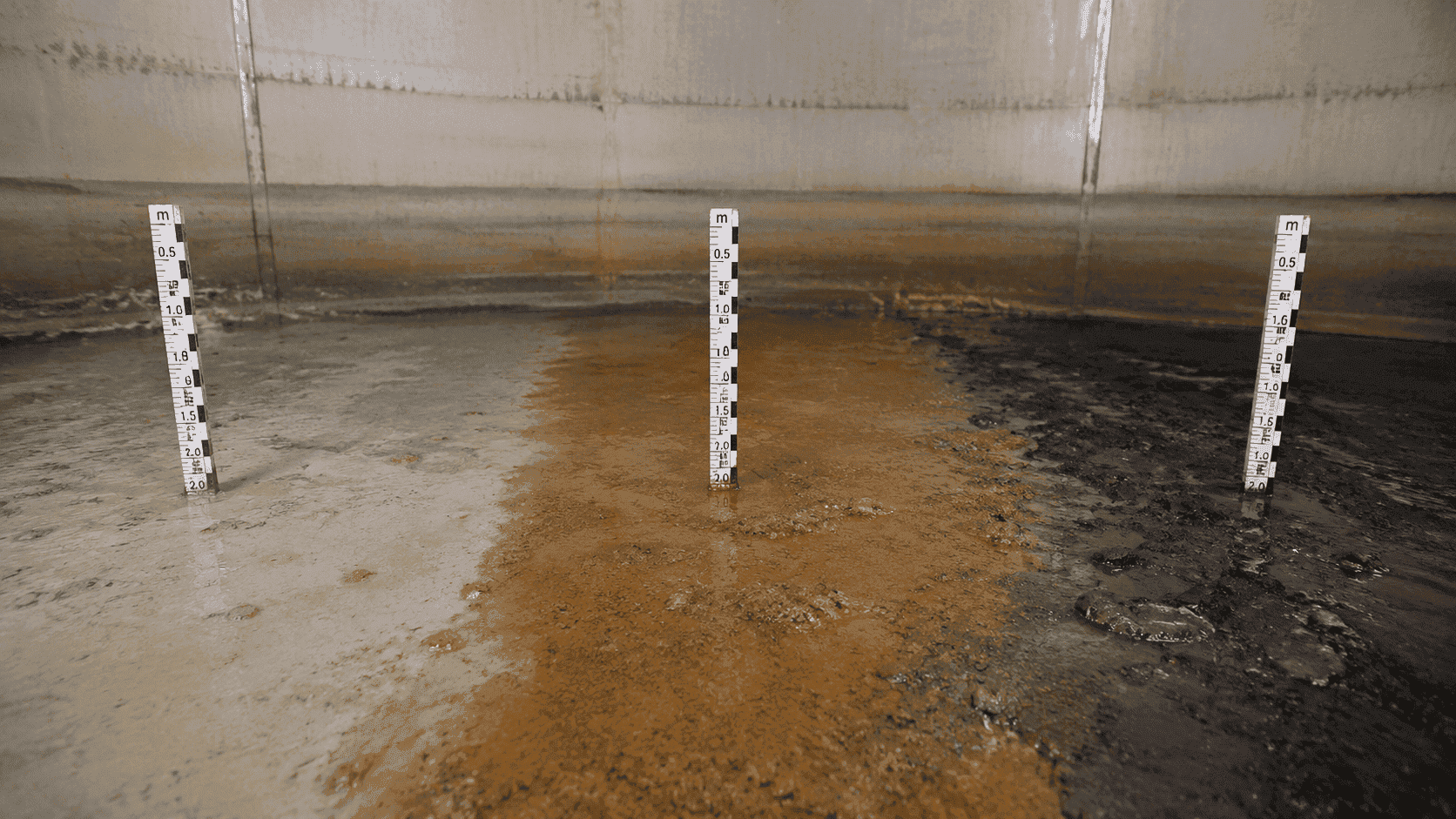
Fine silicate silt (light grey to white)
This is the most common sediment in concrete or GRP reservoirs. It looks like talcum powder - pale, almost chalky, and extremely fine. Below 5mm it sits in a thin, barely-visible film across the floor. When disturbed by a probe or ROV thruster wash, it lifts in a slow-rising cloud that hangs in suspension for minutes. Smell is minimal - faintly earthy at most. This type is largely inert at low depths but becomes a turbidity and disinfectant demand problem once it builds past the action threshold.
Iron and manganese precipitate (orange-brown to dark rust)
Common in steel tanks, older bolted panel systems, or any tank drawing water with elevated iron from the distribution network. Colour ranges from rust-orange to a deep brown-black depending on oxidation state. Texture under a probe is more granular than silt - slightly gritty, almost like wet river sand at the coarser end. It stains tank floors permanently and can strip residual chlorine rapidly. Even 3 to 4mm of iron-heavy precipitate around the outlet sump warrants attention.
Biofilm-bound sludge (dark grey to black)
The most serious category. Black or dark grey sediment with a greasy, almost gelatinous texture is a flag for anaerobic biological activity. The smell distinguishes it immediately - sulphurous, like rotten eggs, produced by sulphate-reducing bacteria working in the oxygen-depleted layer at the bottom of the tank. This is not background contamination. Black sludge at any measurable depth represents a microbial risk and requires urgent assessment under the ADWG guidance on microbial water quality.
Below approximately 5mm, sediment in a well-operated potable tank is often characterised as background accumulation - the result of normal particulate settling over a standard 12 to 24 month inspection cycle. This does not mean it is acceptable indefinitely, but it is generally not generating the water quality outcomes that define a compliance risk.
At 5mm, the picture starts to change. That is roughly the depth at which sediment around the outlet sump begins to influence draw-down turbidity, the anaerobic micro-environment at the sediment-water interface becomes self-sustaining, and disinfectant demand from the sediment mass becomes measurable in residual chlorine monitoring.
Fifteen millimetres represents the depth at which you have crossed from a water quality management issue into a structural and compliance issue. At this depth, an outlet mounted at standard floor clearance (typically 50 to 75mm above slab) is operating with sediment consuming 20 to 30% of that clearance space. The sediment mass is large enough to generate sustained biological oxygen demand. The ADWG turbidity guideline of 1 NTU at the consumer tap becomes difficult to guarantee during any demand surge or hydraulic disturbance. And AS 4020 materials compliance is effectively undermined - the tank floor coating or concrete surface cannot be assessed, maintained, or verified under a sediment layer of this depth.
Sediment does not just sit there. It chemically and biologically interacts with the water column above it - stripping disinfectant, generating turbidity on disturbance, and sheltering microbial populations from chlorine contact. By the time you can see it clearly on an ROV feed, you are already past the point where passive monitoring is enough.
Understanding the threshold is only useful if you can accurately measure against it. In practice, four methods are used - often in combination.
Calibrated depth probe or sediment gauge
A graduated rod or probe is lowered to the tank floor and the reading taken at the water surface. Reliable for concrete floors with consistent texture; less reliable where sediment compacts unevenly or where an outlet sump creates a local depth concentration. Readings should be taken at a minimum of five locations across the floor, including within 500mm of the outlet.
ROV with calibrated reference markers
A Remotely Operated Vehicle equipped with a laser scaling system or physical reference rods provides real-time visual depth assessment without dewatering. The ROV camera captures the sediment layer against a known reference - typically a painted marker on the tank wall at 10mm and 25mm intervals. This is the most accurate method for tanks that remain in service, and the only method that generates a photographic record at multiple floor positions.
Diver observation and sampling
Where ROV access is restricted by tank geometry or outlet configuration, a diver can physically assess sediment texture, take core samples, and produce a floor map. Core sampling is the only method that reliably distinguishes compacted silt from biofilm-bound sludge by visual and olfactory inspection of the vertical sediment profile.
UAV / drone pre-inspection
A drone pass through the tank hatch before dewatering or ROV deployment provides a broad floor overview and allows the inspection team to prioritise areas of concern before deploying more detailed measurement resources.

Australia's regulatory context for potable tank sediment draws from three overlapping frameworks. The Australian Drinking Water Guidelines set the health outcome targets - 1 NTU turbidity at the point of supply, E. coli absence in 100 mL samples, and acceptable aesthetic limits for iron, manganese, and odour. Sediment is a direct pathway risk for all three.
AS 4020 - products in contact with drinking water - governs the materials in contact with stored potable water. A sediment layer of 10mm or more effectively removes the floor lining or concrete surface from compliance verification. You cannot confirm the surface beneath is intact, clean, and non-leaching while it is buried.
State water authority requirements vary but generally follow the ADWG as the baseline. In Queensland, drinking water service providers operate under the Water Supply (Safety and Reliability) Act 2008, which requires documented water quality management plans. Sediment accumulation that generates a water quality event is a reportable incident under that framework.
If your potable storage tanks are on a 24-month inspection cycle without interim sediment monitoring, you are almost certainly operating blind on this question. Twelve months of normal operation in a concrete reservoir fed by a surface water source can generate 8 to 12mm of silt accumulation in a low-flow zone - well within the action band.
PC Water Infrastructure's ROV inspection service allows sediment depth mapping without taking a tank offline. The ROV floor survey produces a photographic record at multiple floor stations, with sediment depth referenced against calibrated markers and tied to outlet proximity. For a 500 kL to 2 ML reservoir, a typical ROV sediment assessment takes under four hours.
For remote assets - including community water schemes in Queensland and the Northern Territory - this matters especially. A tank that has been unmonitored for 18 to 24 months due to access constraints may have crossed the 15mm threshold without any visible water quality signal at the tap, because the sediment has not been disturbed. The problem is invisible until it is not.
With over 20 years inspecting and cleaning water storage infrastructure across Australia - from Pilbara mining camps to remote Indigenous community schemes like Doomadgee - we know what the floor of a neglected tank looks like. It rarely looks like the threshold you would act on. It usually looks like you left it one inspection cycle too long.
| Sediment depth | Action |
|---|---|
| Under 5mm | Document and monitor at the next scheduled inspection. |
| 5 to 15mm | Schedule cleaning and sediment removal. Conduct interim water quality testing if a demand surge or pressure event has occurred since the last inspection. |
| Over 15mm | Immediate action. Commission a full sediment removal, floor inspection, and ADWG-referenced water quality assessment. Do not defer. |
If you are unsure which category your tank falls into, a sediment depth assessment - using ROV without dewatering - is the fastest way to find out.
What is the maximum allowable sediment depth in a potable water storage tank?
There is no single national standard that prescribes a precise maximum sediment depth. However, the practical action threshold used by experienced inspection contractors in Australia is 5 to 15mm. Below 5mm, sediment is typically background accumulation. Between 5mm and 15mm, cleaning should be scheduled. Above 15mm, the sediment mass creates measurable turbidity risk, disinfectant demand, and potential microbial risk inconsistent with the Australian Drinking Water Guidelines' 1 NTU turbidity guideline and the materials compliance intent of AS 4020.
How do you measure sediment in a water storage tank without draining it?
The two primary methods for measuring sediment without dewatering are a calibrated depth probe lowered to the tank floor, and an ROV (Remotely Operated Vehicle) equipped with reference markers or a laser scaling system. ROV inspection is the most accurate method because it provides a photographic record at multiple floor locations, including outlet proximity, and is not affected by uneven sediment distribution that can skew single-point probe readings.
What does sediment in a water tank smell like?
Sediment smell varies by type. Fine silicate silt typically has a faint earthy or mineral odour and is not strongly noticeable. Iron and manganese precipitate has a metallic quality. The most concerning sediment, dark grey or black biofilm-bound sludge, produces a distinctly sulphurous smell similar to rotten eggs. This is produced by sulphate-reducing bacteria operating in the anaerobic layer at the sediment-water interface and indicates biological activity that warrants urgent assessment.
Can sediment in a water tank affect chlorine levels?
Yes. Sediment exerts a biochemical oxygen demand on the water column above it, which consumes residual chlorine. In a tank with 10 to 15mm of accumulated silt or organic sediment, chlorine residuals can drop measurably in the bottom third of the water column, the zone closest to the sediment layer. This effect is amplified during low-demand periods when water turnover is slow, and can contribute to the loss of disinfection residual at the point of supply, which is a water quality risk under the Australian Drinking Water Guidelines.
How often should potable water tanks be cleaned to prevent sediment build-up?
Cleaning frequency depends on source water quality, tank turnover rate, and inlet configuration. As a general guide, most potable storage reservoirs on a reticulated network benefit from inspection every 12 to 24 months and cleaning when sediment depth reaches the 5 to 15mm action threshold. Tanks fed by surface water sources or with slow turnover may accumulate sediment more rapidly and require shorter intervals. An ROV sediment depth assessment at each inspection cycle is the most cost-effective way to calibrate your cleaning frequency to actual conditions rather than a fixed schedule.
Not sure what is on your tank floor? An ROV sediment assessment measures depth against calibrated markers without dewatering - and gives you a written depth report for your asset management documentation.
Book an ROV sediment assessment