

A failing coating is not a single problem with a single cause. The way a coating fails — where it lifts, how it blisters, whether it undercuts from an edge — is diagnostic. Read it correctly and you can tell whether you are looking at a surface issue, a preparation failure, or a structural warning.
Protective coatings are the first line of defence for steel water storage. When they fail, the substrate corrodes, water quality is put at risk, and the clock starts on more expensive intervention. But two tanks with "coating failure" can need completely different responses. This is how to tell them apart.
Blistering
Raised bubbles under the coating film, ranging from pinhead to coin-sized. Blistering is usually osmotic — moisture or soluble salts trapped beneath the film draw water through the coating and lift it. It points to contamination on the steel at the time of application, or a coating applied over an inadequately cleaned surface. Blisters that break become active corrosion sites.
Delamination and disbondment
Whole sheets of coating losing adhesion and peeling away from the substrate. Where blistering is localised, disbondment is systemic — it usually indicates a preparation failure across an area: poor surface profile, contamination, or an incompatible coating over an old system. Disbonded coating is no longer protecting anything, even where it still looks intact.
Undercutting and filiform corrosion
Corrosion that creeps sideways underneath the coating from a scratch, edge, or holiday — often as fine thread-like lines. Undercutting is the reason a small mechanical nick becomes a large delaminated patch: once the substrate corrodes under the film, the corrosion product wedges the coating off from below.
Holidays and pinholes
Tiny gaps in the film — missed spots, pinholes, or thin areas — that expose bare steel. Individually trivial, collectively they are where corrosion initiates. Holiday detection is a standard part of any competent coating inspection precisely because the naked eye misses them.
Chalking
A powdery surface and loss of gloss as the binder degrades, typically from UV on external surfaces. Chalking alone is often cosmetic, but it signals the coating is nearing the end of its protective life and thinning toward the substrate.
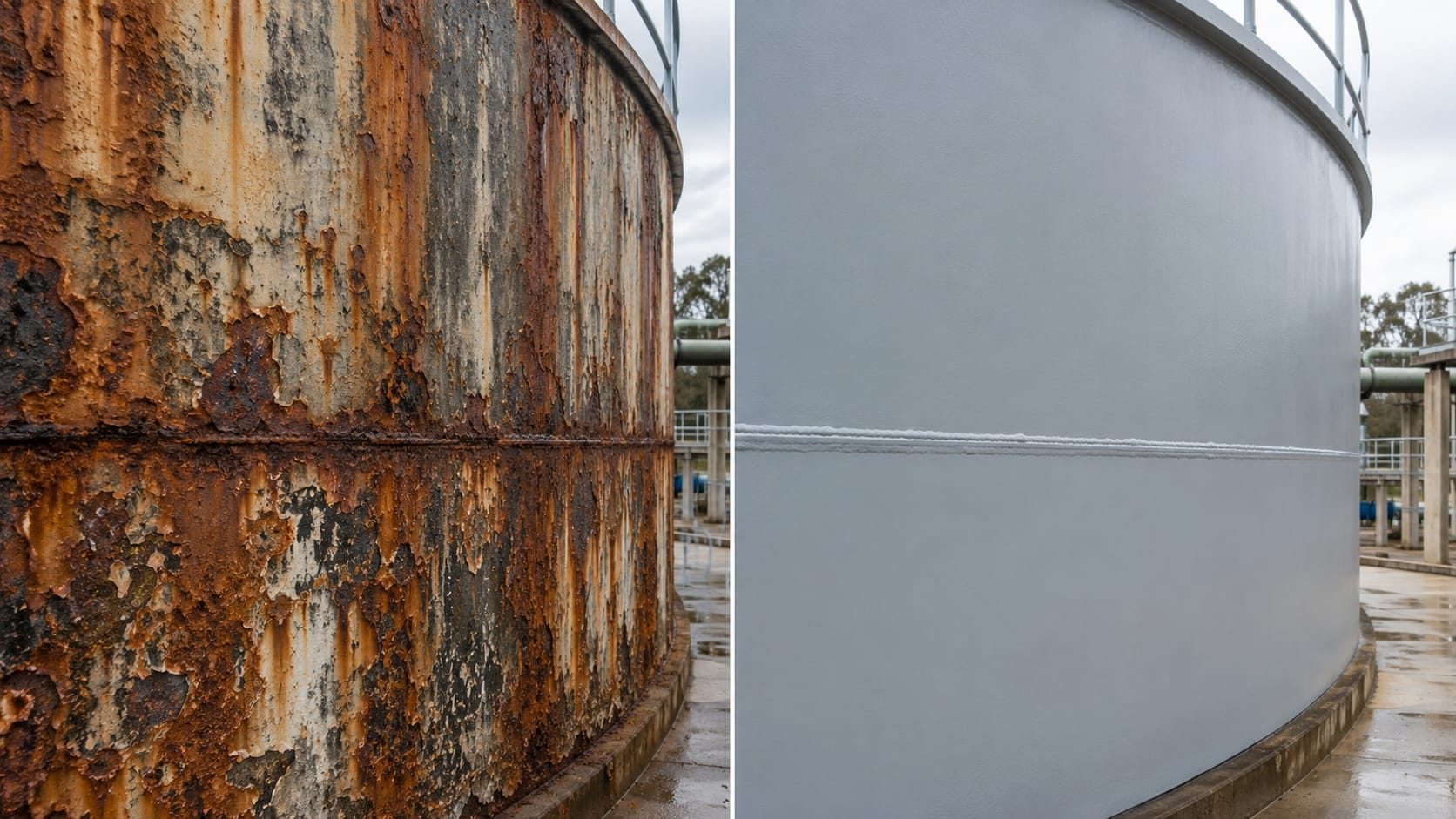
Coating film is always thinnest where the geometry is sharpest — cut edges, weld seams, bolt heads, and corners. Surface tension pulls wet coating away from an edge as it cures, leaving it under-protected exactly where mechanical and corrosive stress is highest. When you inspect a tank, the edges and seams tell you how the coating will age long before the flat panels do.
The single biggest determinant of coating life is not the coating — it is the surface preparation beneath it. A premium product applied over contaminated or poorly profiled steel will fail years ahead of a modest product applied correctly.
Not every coating failure is a recoat. Where disbondment is widespread, where undercutting has already pitted the substrate, or where the tank cannot practically be dried and prepared for a fresh coating in service, an RPVC liner system is often the more durable answer — a new, watertight internal membrane that restores compliance without depending on the condition of the original coated surface.

| Observation | What it usually means |
|---|---|
| Localised blistering | Contamination or salts under the film — monitor and spot-repair before blisters break |
| Widespread disbondment | Preparation failure across an area — the coating is no longer protecting; plan remediation |
| Undercutting from edges / scratches | Substrate corroding beneath the film — small defects are becoming large ones |
| Holidays / pinholes | Bare-steel initiation points — detect and seal before they spread |
| Chalking with film thinning | Coating nearing end of protective life — schedule recoat or reline |
Is coating blistering always a problem?
Intact, unbroken blisters are a warning rather than an emergency — they indicate contamination or moisture under the film. Once a blister breaks, it exposes bare steel and becomes an active corrosion site. Localised blistering can often be spot-repaired; widespread blistering usually points to an application or preparation problem across the surface.
Can you just recoat over a failing coating?
Only where the existing coating is sound and compatible. Coating over disbonded, contaminated, or incompatible film simply traps the problem underneath — the new coat fails with the old one. Where the substrate is pitting or the old system has broadly disbonded, relining is generally more durable than recoating.
Why do coatings fail at welds and edges first?
Wet coating pulls away from sharp geometry as it cures, so the film is always thinnest at cut edges, welds, bolt heads and corners — exactly where corrosive and mechanical stress is highest. Competent application uses stripe coating on these details for that reason.
Not sure whether your tank needs a recoat, a targeted repair, or a reline? A condition assessment reads the coating failure for what it is — and gives you a defensible next step.
Request a condition assessment