
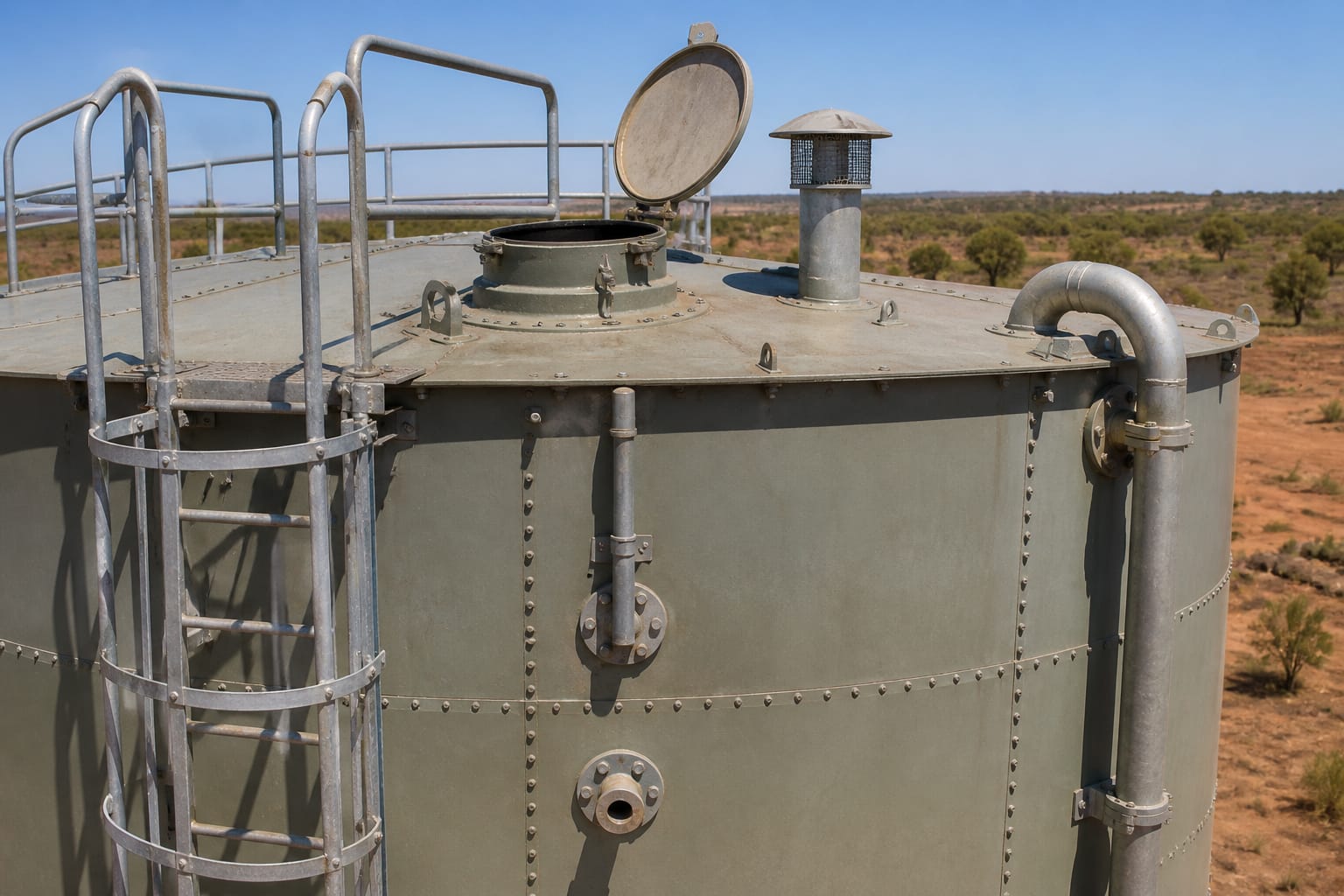
Two of the most common entry points for contamination into an otherwise well-maintained tank are also two of the easiest to overlook: the overflow pipe, which by design has to allow water out, and the vent, which by design has to allow air in and out. Both are, functionally, holes in an otherwise sealed structure — and both need proper screening to stay that way in every other respect.
Screening standards specify mesh size, material and installation detail precisely because an inadequately screened opening does not just admit occasional insects. It can become a regular entry point for vermin and, in cases severe enough to be genuinely common in tank inspection findings, for birds — and a bird carcass inside a tank is a serious water quality event, not a minor housekeeping issue.
Screens degrade in ways that are easy to miss
Mesh screening corrodes, gets knocked loose during other maintenance work, or is simply omitted during a repair if the person doing the repair is not specifically thinking about contamination control — the pipe gets fixed, and the screen that was supposed to be reinstalled is not. A screen that is present at commissioning is not guaranteed to still be present, or still effective, years later without specific inspection attention.
The overflow gets treated as a low-priority fitting
Overflow pipes are frequently the least-inspected fitting on a tank precisely because they rarely activate — a tank that is well-managed and rarely overflows means the overflow screen can go unchecked for extended periods simply because nobody has reason to look at it during normal operation. This is exactly the kind of low-attention fitting that benefits from being on a deliberate inspection checklist rather than relying on incidental discovery.
Mesh sizing that actually excludes the relevant pests
Screening mesh needs to be fine enough to exclude insects and small vermin while still allowing adequate airflow or water discharge — too fine and the screen can restrict venting or overflow capacity, too coarse and it fails to exclude the pests it is meant to stop. This is a specified detail, not a "any mesh will do" fitting choice.
Downward-facing or otherwise protected outlets
Good overflow and vent design typically directs the opening downward or otherwise shields it from direct rainfall and debris ingress, in addition to screening against insects and vermin — screening alone does not address every contamination pathway an opening can present if its orientation and protection are not also considered.
The overflow and vent are the two openings every sealed tank still needs to have. Proper screening is what keeps "needs to have" from turning into "an open door for whatever finds it."
| Check | Why it matters |
|---|---|
| Screen present and intact at both overflow and vent | The most basic and commonly overlooked check |
| Mesh sizing appropriate for pest exclusion without restricting flow | Incorrect mesh size undermines either function or protection |
| Included as a deliberate item on routine inspection | Rarely-activated fittings like overflows are easy to forget otherwise |
| Outlet orientation and protection assessed alongside screening | Screening alone does not address every ingress pathway |
Why is overflow screening often overlooked during tank maintenance?
Overflow pipes rarely activate on a well-managed tank, so the fitting gets little natural attention during normal operation. Screens can corrode, be knocked loose, or be left off after unrelated repairs without anyone noticing until a specific inspection checks it deliberately.
Can an unscreened vent really let a bird into a tank?
Yes, and it is a documented and recurring finding in tank inspections. Birds finding their way into inadequately screened tanks is a genuine water quality risk, which is why vent and overflow screening standards exist and why checking them is a standard part of proper tank inspection.
What mesh size should be used for overflow and vent screening?
The correct mesh size depends on the applicable standard and the tank's specific overflow and venting capacity requirements — it needs to exclude insects and vermin without unduly restricting airflow or overflow discharge. This should be specified rather than assumed, since "any mesh" is not an adequate approach.
Not sure if your tank's overflow and vent screening is intact or adequate? PC Water Infrastructure includes this in every tank inspection.
Book a Tank Inspection