
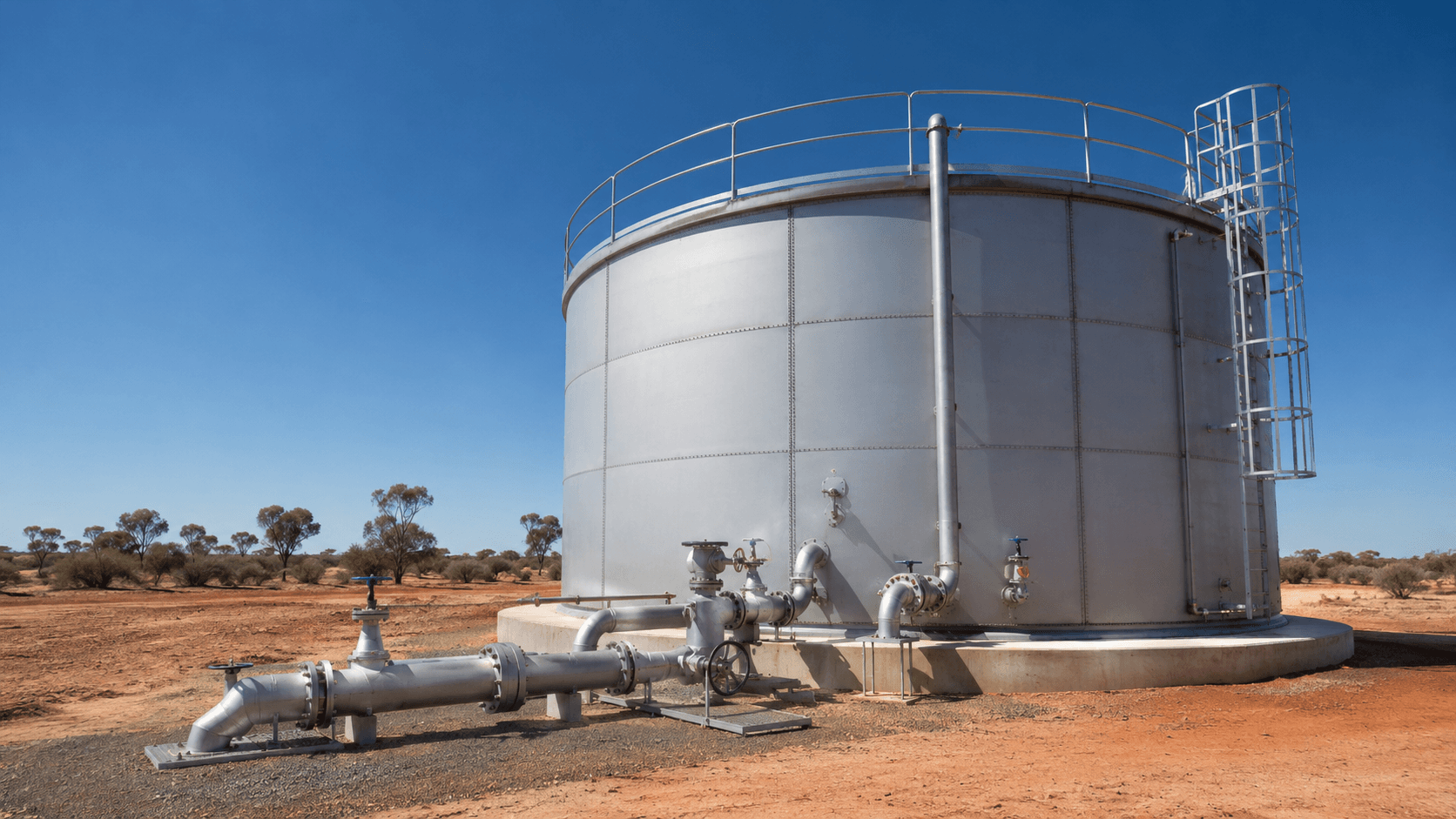
It seems counterintuitive that a large steel tank needs help resisting wind — the shell looks massive and solid. But a thin-walled cylindrical structure, particularly when empty or partly empty, is far more vulnerable to wind-induced buckling than its overall size suggests, and wind girders exist specifically to address that vulnerability.
Steel tank walls are engineered to be as thin as the structural design safely allows, primarily to manage material cost and weight. That thinness is fine for resisting the outward hoop stress of a full tank of water, but it leaves the shell relatively weak against the inward, buckling-type loads that wind pressure applies to a large-diameter cylinder — especially near the top, where the shell is least restrained by hydrostatic pressure from stored water.
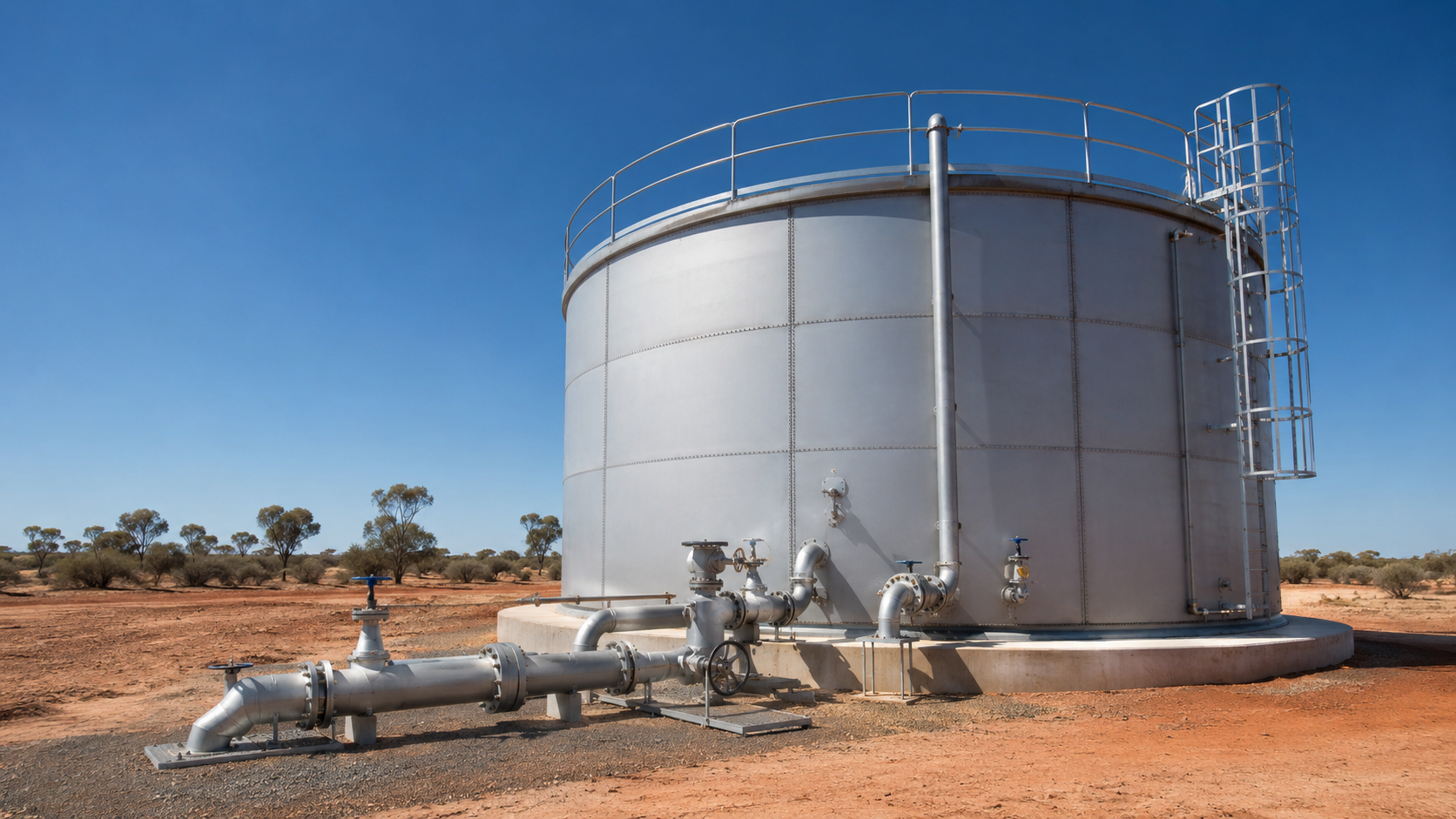
Wind girders resist shell buckling
A wind girder is a stiffening ring, typically positioned near the top of an open-top or floating-roof tank, engineered to maintain the shell's circular cross-section under wind load. Without it, wind pressure acting on a large-diameter thin shell can deform the top of the tank out of round, and in severe cases cause localised or full shell buckling — a failure mode that has nothing to do with the tank's water-holding capacity and everything to do with its structural stability as an empty or partly empty cylinder.
Intermediate stiffening rings for taller tanks
Taller tanks, or tanks in higher wind regions, may require intermediate stiffening rings at additional heights along the shell, not just at the top. The specific requirement is calculated from shell height, diameter, plate thickness and the design wind speed for the site — it is a structural engineering calculation, not a standard fitting applied uniformly regardless of tank geometry.
Empty tanks are the vulnerable condition
The scenario that actually matters for wind girder design is an empty or low-level tank exposed to design wind speed — precisely the condition a tank might be in during construction, maintenance shutdown, or a period of low demand. A tank that will never realistically be emptied still needs to be designed for that condition, because maintenance, inspection or an unplanned supply interruption can put it there regardless of intended operating pattern.
Retrofitting is far harder than designing it in
Wind girder requirements are a shell design decision made at the engineering stage, using the site's specific wind loading data. Retrofitting adequate wind stiffening to an existing under-designed tank is a significant structural intervention, not a simple add-on — which is why getting this right during design, rather than discovering the gap later, matters considerably more than it might initially appear.
A tank does not need to be full of water to fail structurally. An empty, thin-walled shell under design wind load is its own distinct engineering problem, and wind girders are the answer to that specific problem.
| Check | Why it matters |
|---|---|
| Wind girder sized to site-specific design wind speed | Generic sizing does not account for actual local wind loading |
| Empty-tank condition checked explicitly | The critical structural case, not the full-tank operating condition |
| Intermediate stiffening assessed for tall shells | Taller tanks may need more than a single top wind girder |
| Design reviewed for tanks in cyclone-prone regions | Wind loading requirements can differ substantially by region |
Do all steel water tanks need wind girders?
Not necessarily — the requirement depends on shell height, diameter, plate thickness and site wind loading. Smaller-diameter or shorter tanks may not require additional stiffening, while large-diameter or tall tanks, particularly open-top designs, typically do. This should be confirmed by structural calculation, not assumed either way.
Why is an empty tank more vulnerable to wind damage than a full one?
A full tank's stored water provides internal hydrostatic pressure that helps resist inward buckling forces. An empty or low-level tank has none of that support, leaving the thin steel shell to resist wind load largely on its own structural stiffness — which is why empty-tank wind loading is the governing design case for shell stiffening.
Can a wind girder be added to an existing tank later?
It is possible in some cases but represents a significant structural retrofit rather than a simple addition, and needs proper engineering assessment of the existing shell condition and capacity. It is considerably more straightforward to design adequate stiffening in at the original engineering stage.
Designing or reviewing a large-diameter steel tank? PC Water Infrastructure applies site-specific structural engineering to every tank design, including wind loading.
Discuss Tank Structural Design