

A full water tank's own weight is a significant stabilising force against wind loading — often enough, by itself, to resist overturning and uplift without relying heavily on anchorage. An empty or substantially drawn-down tank loses that advantage precisely when it is most exposed, during maintenance, commissioning, or a drought-driven low-level event.
Dead weight as a stabilising force
The stored water's weight bears down on the foundation, resisting the uplift and overturning forces wind exerts on the tank's roof and walls. Remove that weight — during cleaning, maintenance, commissioning, or a drought drawdown — and the tank's resistance to wind uplift depends almost entirely on its anchorage and structural design, not its contents.
Roof uplift specifically
Wind passing over a tank roof can generate a genuine aerodynamic lift force, similar in principle to how wind generates lift on an aircraft wing, particularly on lightweight roof structures like some floating or geodesic dome designs. A full tank's internal pressure and the water's mass both help counteract this; an empty tank's roof is more exposed to net uplift force.

Anchorage and structural design account for the empty-tank wind load case as part of a properly engineered specification — but that design assumption is only protective if maintenance planning respects it too. Scheduling a tank drawdown or empty-tank maintenance period during a known high-wind season, without confirming the tank's anchorage adequacy for that specific empty-tank condition, introduces a risk the original design may not have anticipated for that particular timing.
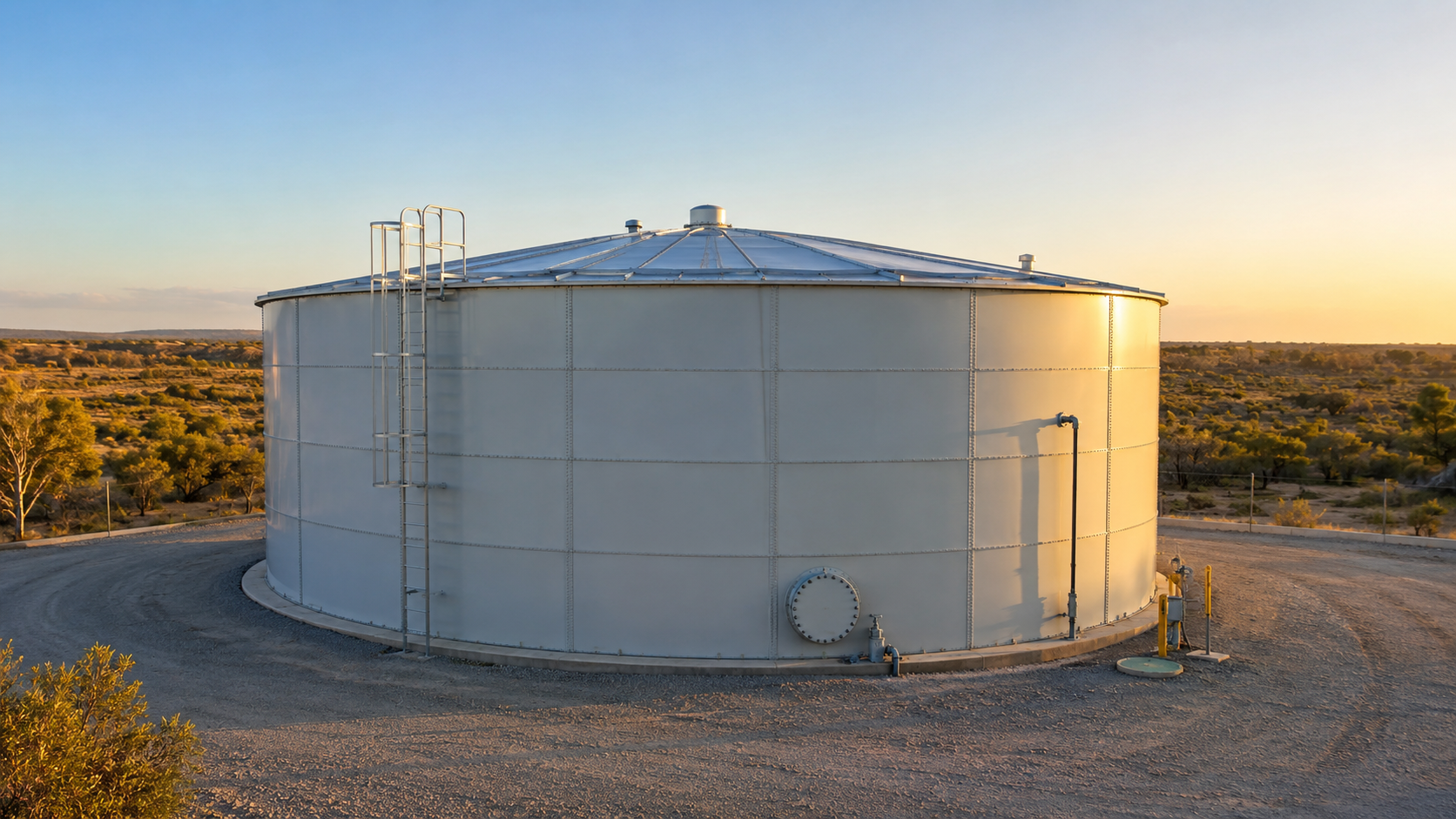
A tank's wind resistance is not a fixed property — it changes with how full the tank is. Anchorage design has to account for the worst case, which is usually empty, not the everyday case of a full or partially full tank.
| Consideration | Why it matters |
|---|---|
| Anchorage designed for the empty-tank wind load case | The design condition with the least stabilising weight available |
| Roof structure checked for wind uplift resistance | Lightweight roof structures are particularly exposed when the tank is empty |
| Maintenance scheduling avoiding known high-wind periods where practical | Reduces unnecessary exposure during the tank's most vulnerable condition |
| Anchorage condition inspected periodically | Corrosion or damage to anchor bolts reduces uplift resistance over time |
| Drought or low-level contingency plans consider wind exposure | An unplanned extended low-level period carries the same uplift risk as scheduled maintenance |
Is wind uplift only a risk while a tank is being actively maintained?
No — any period where the tank is empty or significantly drawn down carries elevated wind uplift risk, including an unplanned drought-driven low-level event, not just a scheduled maintenance drawdown. Anchorage design should account for the empty condition regardless of why it occurs.
How can I tell if my tank's anchorage is adequate for the empty-tank wind load case?
A structural review against the applicable wind design standard, specifically checking the empty-tank condition, can confirm whether the anchorage was designed for this case and whether current anchor condition (checking for corrosion or damage) still provides that capacity.
Should tank maintenance be scheduled around wind season?
Where practical, scheduling empty-tank maintenance outside known high-wind periods is a sensible additional precaution, though it does not replace the need for anchorage properly designed for the empty-tank condition in the first place — maintenance timing is a mitigation, not a substitute for correct design.
Planning a tank drawdown or maintenance period, or reviewing anchorage adequacy? Confirming empty-tank wind resistance protects the asset when it is most exposed.
Discuss anchorage and wind loading review