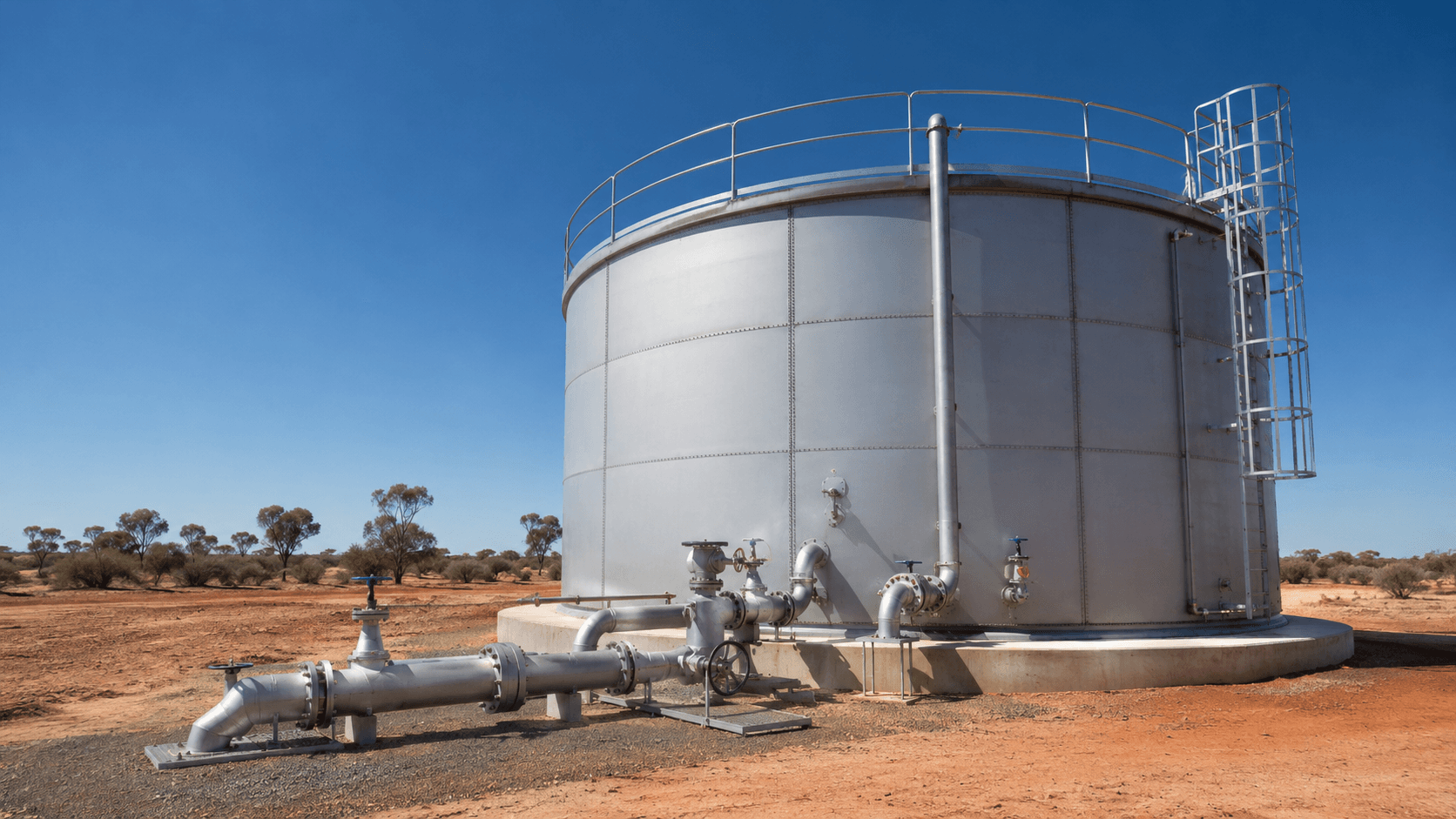
Steel water tanks are built one of two ways: bolted panels assembled on site, or steel plate welded into a single continuous shell. Both produce a compliant, long-lived tank. The decision between them is rarely about which is "better" — it is about which construction method actually fits the site, the program and the way the asset will be operated.
Bolted tanks are assembled from pre-galvanised or coated steel panels, joined with bolts and internal or external sealant systems. They are manufactured off site, delivered as flat-packed panels, and erected on prepared foundations — often in days rather than weeks. Welded tanks are fabricated from steel plate, either shop-welded in sections and finished on site, or fully field-welded shell-up from the base plate. The result is a monolithic structure with no mechanical joints in the shell itself.
Site access and program
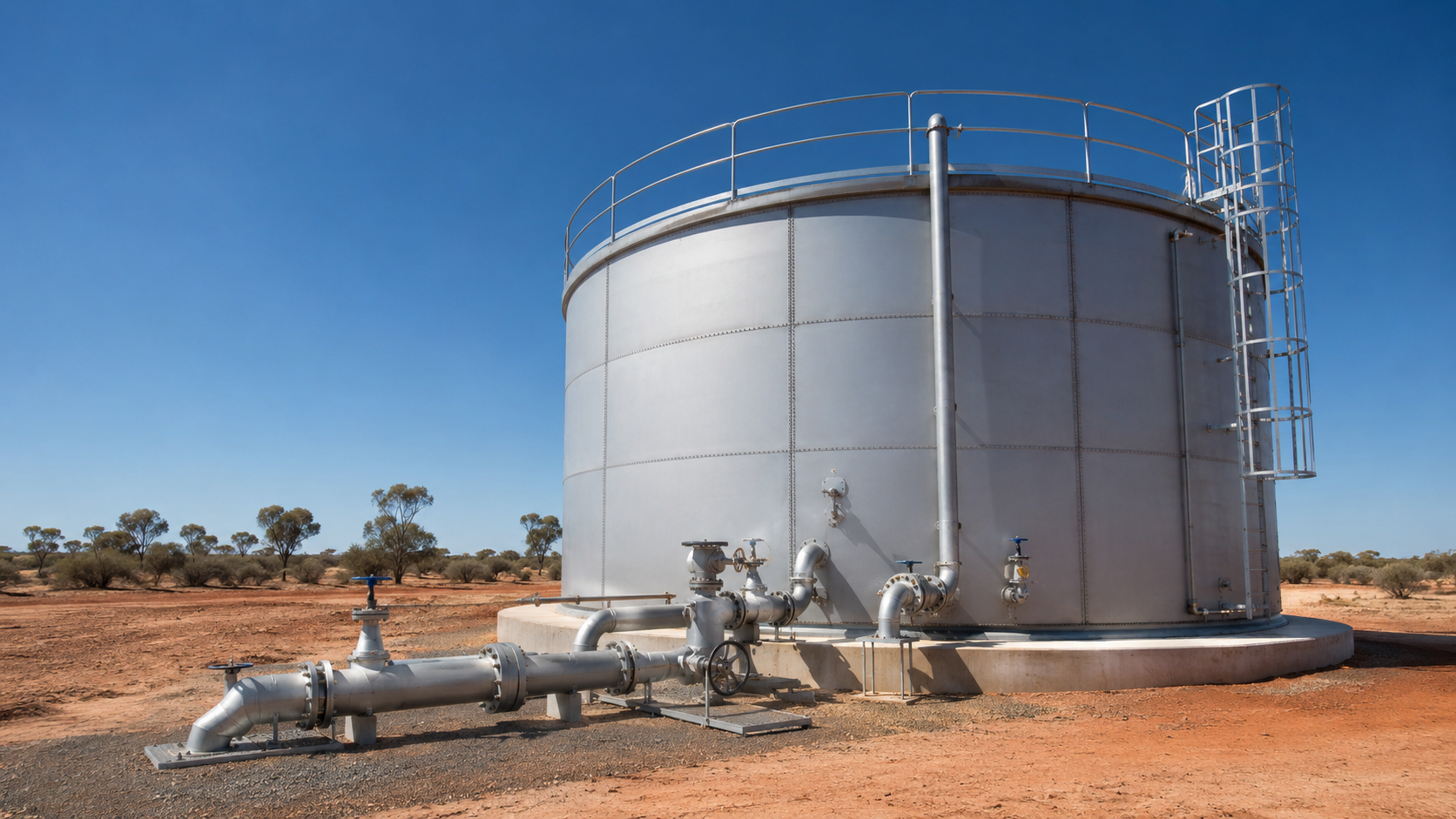
Bolted tanks win when site access is constrained or the program is tight. Panels can be delivered on standard trucks, carried through a gate a welded shell could never fit through, and erected with a mobile crane and a small crew. For remote sites, this dramatically reduces the logistics burden — no welding plant, no shielding from wind for weld quality, no extended site presence for a welding crew. A mid-size bolted tank can often be watertight within one to two weeks of panels arriving.
Welded tanks generally need more site time, more equipment, and more controlled conditions for weld quality — wind, rain and temperature all affect field welding. Where the site allows it and capacity is large, welding can still be the faster option in aggregate, because it avoids handling hundreds of individual bolted joints.
Capacity, geometry and future flexibility
Very large capacities and unusual geometries tend to favour welded construction. A welded shell has no practical panel-size ceiling — capacity is a function of plate thickness and diameter, not panel module dimensions. Bolted tanks are typically limited by standard panel sizes, though manufacturers now offer larger formats that close much of this gap for mid-range capacities.
Bolted tanks also have an underrated advantage: they can sometimes be extended. Adding a course of panels to increase height, where the foundation and structural design allow it, is a realistic upgrade path. Extending a welded tank means cutting into an existing shell — a far more involved structural and safety exercise.
What ongoing maintenance actually looks like
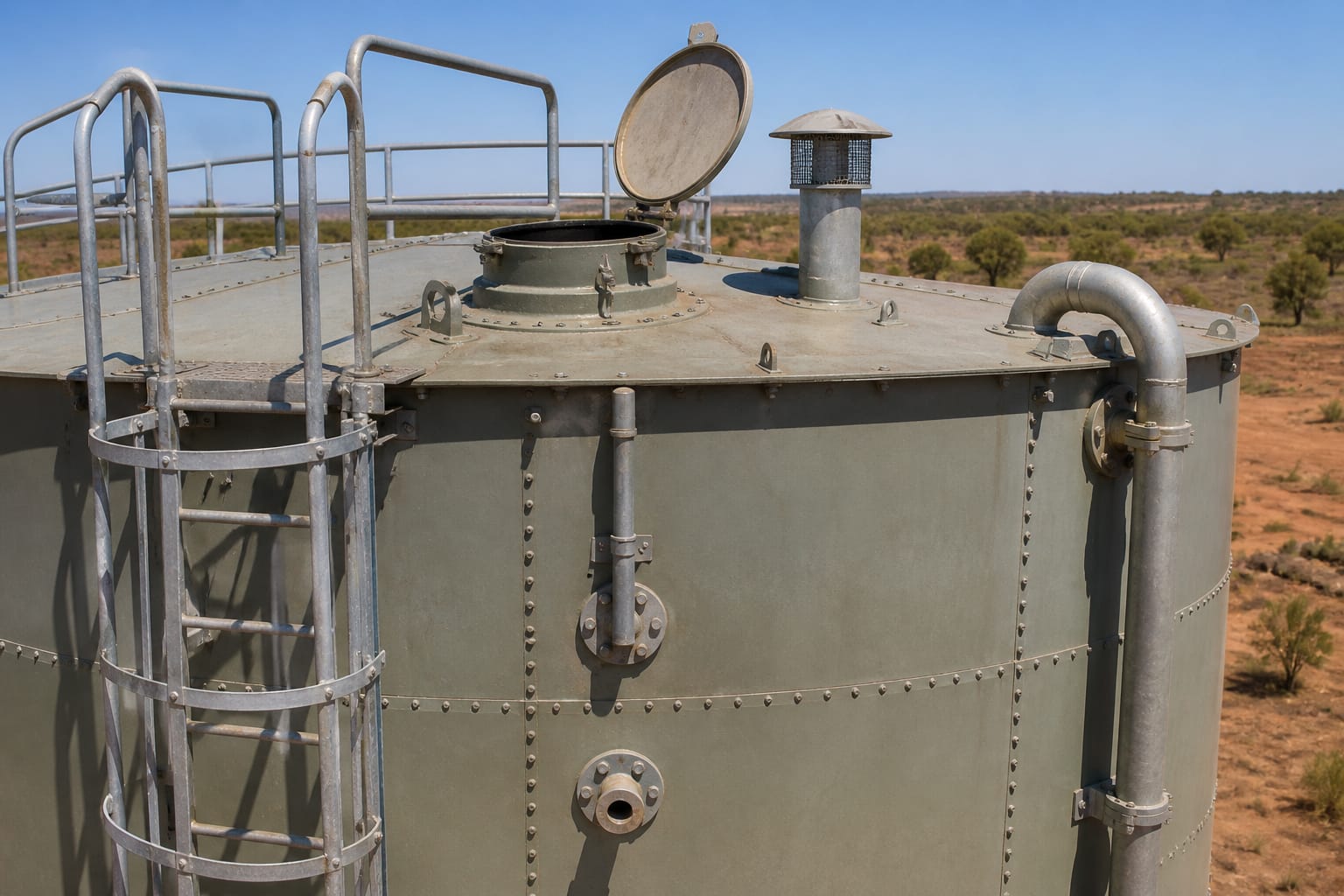
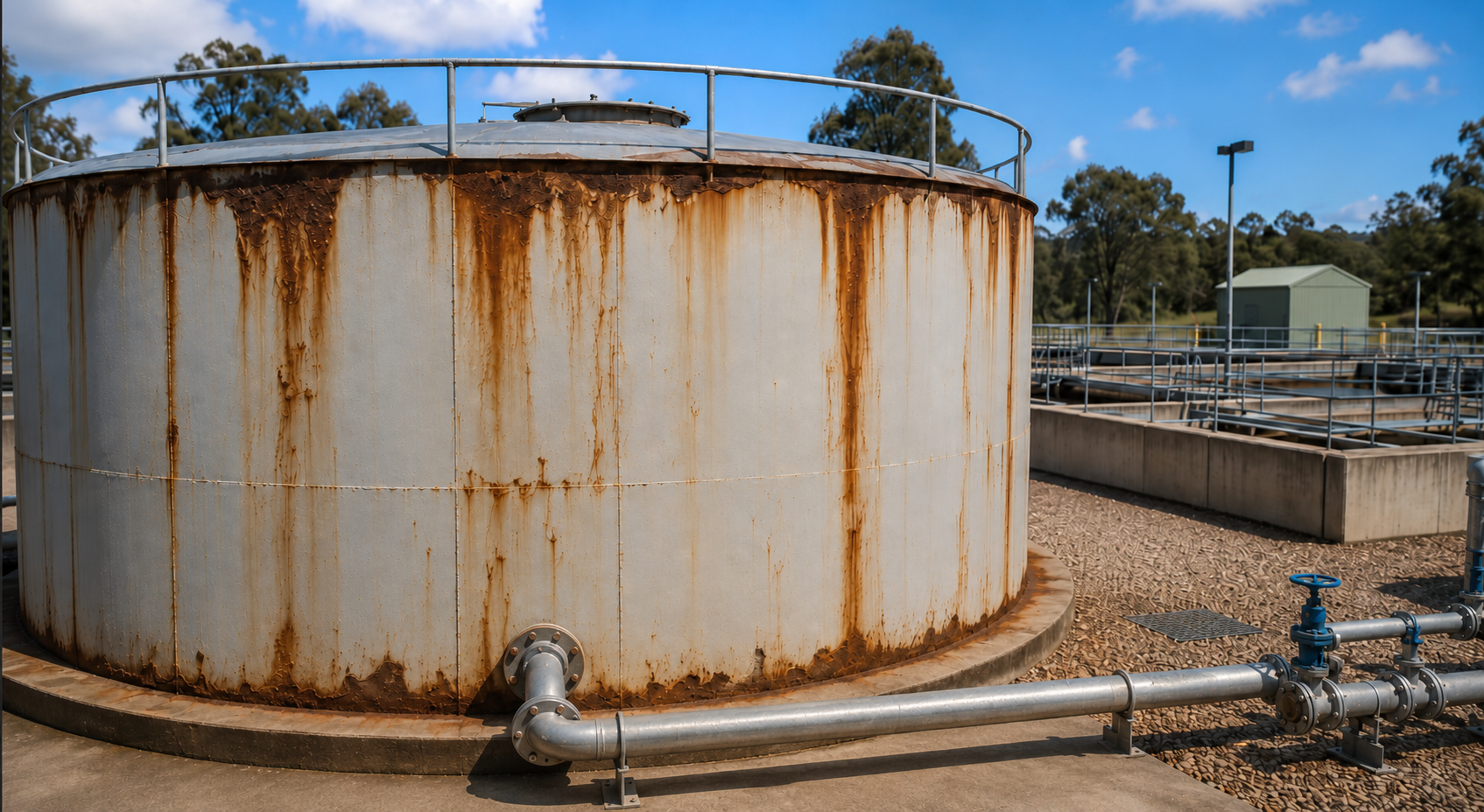
A bolted tank maintenance profile centres on the joints — internal and external sealant condition, bolt torque and corrosion at panel overlaps are the recurring inspection points. Done properly at commissioning and re-checked on a sensible cycle, this is a manageable, well-understood maintenance task. A welded tank maintenance profile centres on coating condition and any localised corrosion, since there are no mechanical joints to fail — but a coating breach on a welded shell can be harder to isolate to one small area than a single degraded panel on a bolted tank.
Decommissioning and relocation
Bolted tanks can, in principle, be disassembled and relocated — a genuinely useful option for temporary sites, staged developments or assets that may need to move. Welded tanks are effectively permanent once erected; decommissioning means demolition, not relocation. If there is any realistic chance the asset needs to move within its service life, that alone can settle the decision in favour of bolted construction.
Neither construction method is more correct — the right tank is the one whose joints, access requirements and future flexibility match what the site and the asset owner actually need over the tank working life.
| Factor | Favours |
|---|---|
| Restricted site access | Bolted |
| Very large capacity or unusual geometry | Welded |
| Tight program with limited site presence | Bolted |
| Possible future relocation | Bolted |
| Preference for zero mechanical joints in the shell | Welded |
Is a welded tank stronger than a bolted tank?
Both are engineered to the same structural standards and, correctly designed, both are fit for their rated capacity and loading. A welded shell has no mechanical joints to maintain, but a properly engineered and installed bolted tank is not structurally inferior — the joints are a maintenance consideration, not a strength deficiency.
Which construction method suits remote sites better?
Bolted tanks are usually the practical choice for remote or access-constrained sites, since panels ship flat and erect quickly with a small crew, without the need to establish and shelter a field welding operation.
Can a bolted tank be upgraded to a larger capacity later?
In some cases, yes — if the foundation and structural design allow for it, additional panel courses can increase height and capacity. This needs to be planned for at the original design stage; it is not a retrofit that can be assumed after the fact.
Planning a new tank and unsure which construction method fits your site? PC Water Infrastructure can assess access, capacity and program to recommend the right build.
Discuss Tank Design