

Most conversations about tank coating failure focus on the coating itself — the wrong product, the wrong film thickness, the wrong number of coats. In practice, the coating is rarely the first point of failure. The surface it was applied to usually is.
Coating adhesion depends on the steel surface being clean, profiled and free of contamination at the moment the coating is applied. Abrasive blast cleaning is how that surface is created, and the industry uses a standardised grading system — SA1 through SA3 under ISO 8501-1 — to describe exactly how much of the original mill scale, rust and old coating has been removed, and what the resulting surface looks like.
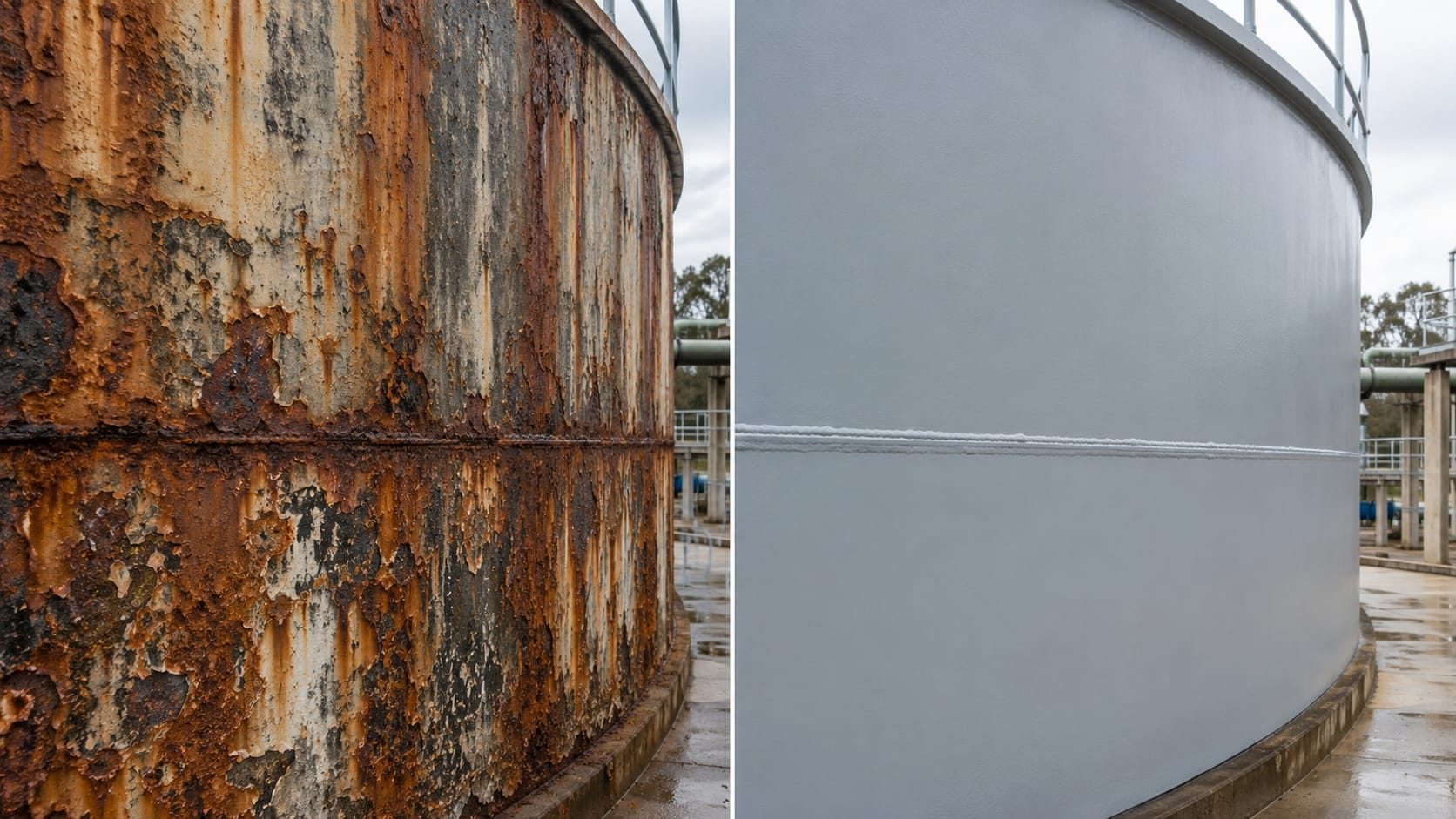
Near-white metal, defined precisely
SA2.5 — "very thorough blast cleaning" — requires the surface to be free of visible oil, grease, dirt, mill scale, rust and old coating, with only slight staining permitted in the form of spots or stripes covering no more than about 5% of the surface area. It sits between SA2 (thorough blast cleaning, more residual staining permitted) and SA3 (white metal, no staining at all). For most immersed or buried steel water tank applications, SA2.5 is the specified minimum — it strikes the balance between coating performance and the cost of achieving a full white-metal finish.
The grade is not a subjective call made on site. It is assessed against ISO 8501-1 photographic reference standards, and a competent inspector checks it methodically — not by walking past and deciding it "looks blasted enough."
Anchor profile matters as much as cleanliness
Blast cleaning does two jobs at once: it removes contamination, and it creates a mechanical anchor profile — a controlled roughness that gives the coating something to key into. Profile depth is specified in microns and matched to the coating system; too shallow and adhesion suffers, too deep and peaks can telegraph through thin-film coatings or trap air that later causes pinholing. Blasting to the right cleanliness grade with the wrong profile depth still produces a coating that underperforms its rated life.
Weather windows and dew point
Freshly blasted steel is chemically active and will begin to re-rust — sometimes visibly within hours — if humidity is high or the steel temperature sits too close to the dew point. This is why coating specifications include a maximum time between blasting and priming, and why site crews monitor dew point continuously during preparation and coating work, not just at the start of the shift. A surface that was SA2.5 at 8am can be unsuitable to coat by 2pm if conditions were not managed.
Contamination from soluble salts is the other quiet failure mode, especially on tanks that have been in marine or industrial-emission environments. Visible cleanliness is not the same as chloride-free steel — salts can remain embedded in pitting after blasting and drive coating blistering months later, well after the tank has returned to service. Where the site history warrants it, a soluble salt test before coating is worth the extra step.
A coating specified to last twenty years will not get there on a surface that was blasted to the right grade on paper but coated outside the dew point window, or over embedded chloride contamination nobody tested for.
| Check | Why it matters |
|---|---|
| Blast grade matches ISO 8501-1 photographic standard | Confirms cleanliness is objectively verified, not visually assumed |
| Anchor profile depth matches the coating specification | Too shallow or too deep both reduce coating performance |
| Coating applied within the specified re-rust window | Freshly blasted steel begins oxidising immediately in humid conditions |
| Steel temperature kept above dew point | Moisture condensation under a fresh coat causes adhesion failure |
| Soluble salt testing where contamination history warrants it | Embedded chlorides cause blistering that visible inspection will not catch |
What does SA2.5 blast cleaning actually remove?
SA2.5 removes mill scale, rust, old coating, oil, grease and dirt from the steel surface, leaving only slight staining across no more than about 5% of the area — assessed against ISO 8501-1 photographic reference standards, not by eye alone.
Why does anchor profile depth matter if the surface is already clean?
Cleanliness and profile are two separate requirements. Profile is the mechanical roughness that gives the coating a surface to key into; the correct depth is specified per coating system, and getting it wrong — too shallow or too deep — reduces adhesion and coating life even on a properly cleaned surface.
How quickly does freshly blasted steel need to be coated?
It depends on humidity and site conditions, but freshly blasted steel can begin visibly re-rusting within hours in humid environments. Coating specifications set a maximum time window between blasting and priming, and crews should monitor dew point throughout, not only at shift start.
Concerned about coating performance on an existing or new tank? PC Water Infrastructure can assess surface condition and specify the right preparation and coating system.
Discuss Tank Coatings