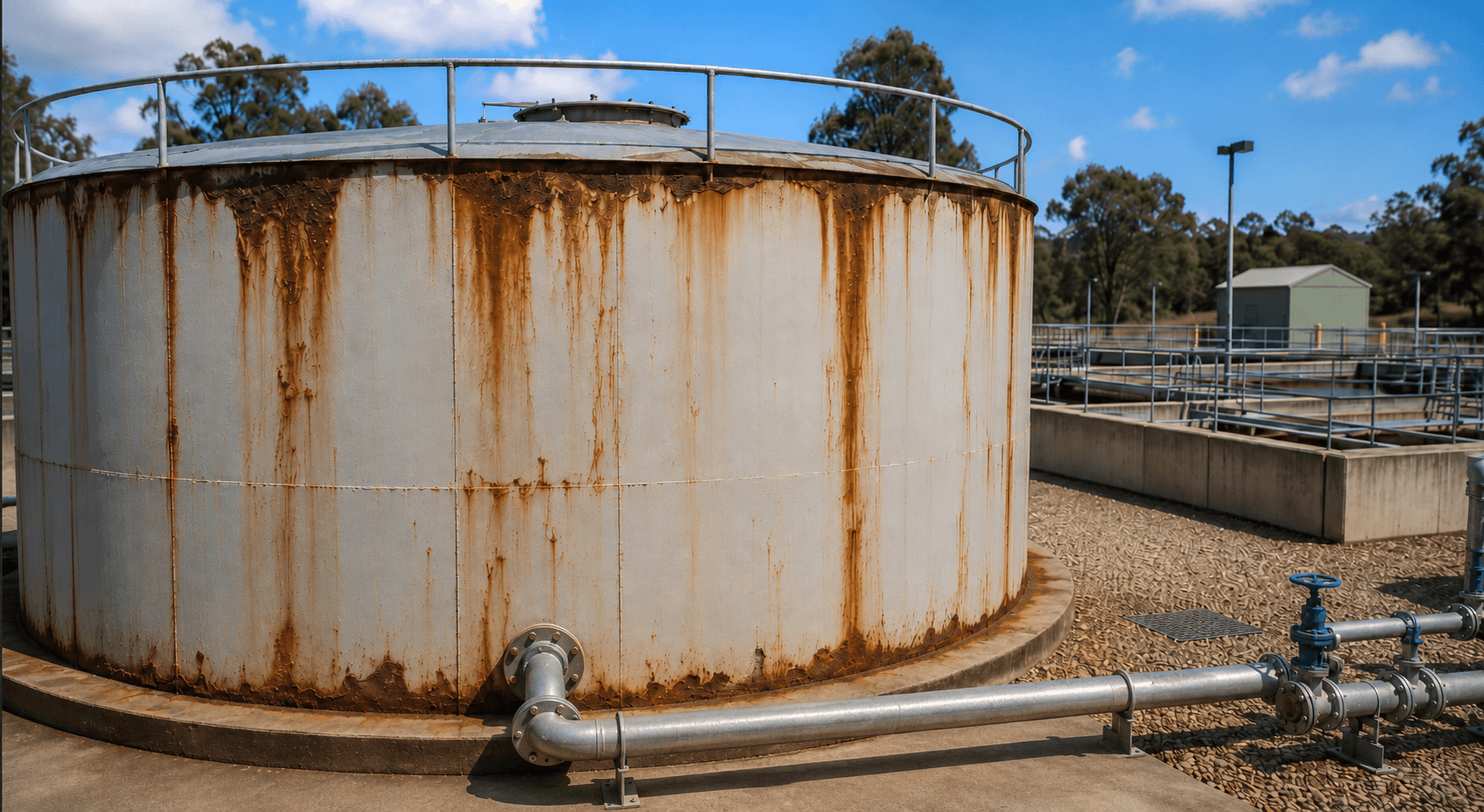
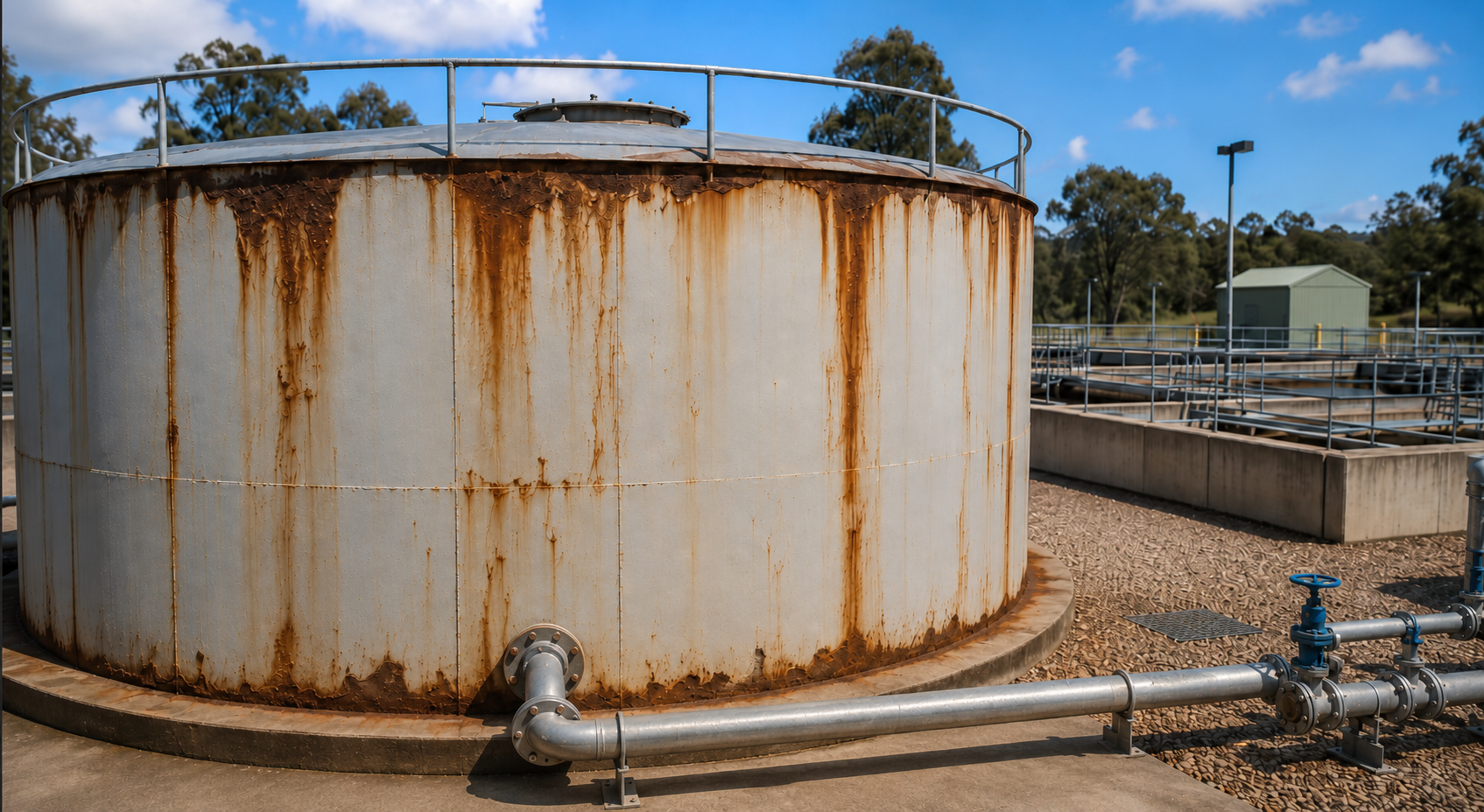
It is a counterintuitive finding on many tank inspections: the steel above the waterline, which never actually touches the stored water, is often more heavily corroded than the submerged steel below it. The vapour space is a distinct corrosion environment, and it needs to be managed as one.
Condensation cycles concentrate corrosive conditions
As a tank's water level rises and falls, and as ambient temperature fluctuates day to night, moisture condenses and evaporates repeatedly on the steel surface above the waterline. This wet-dry cycling, combined with oxygen readily available in the vapour space (unlike the more oxygen-limited submerged zone in some conditions), creates a corrosion environment that can be more aggressive than constant submersion.
Coating performance differs above and below the waterline
A coating system performing well under constant submersion can behave differently under the vapour space's cyclic wetting and drying, and under any residual disinfection gas exposure in a treated potable tank. Coating specification that does not account for this difference can leave the vapour zone under-protected relative to the submerged zone, even where the same product is applied throughout.
Vapour corrosion inhibitors (VCIs)
Vapour-phase corrosion inhibitors release a protective vapour that forms a molecular-level protective layer on exposed metal surfaces, including areas a liquid-phase treatment cannot easily reach — a targeted way to protect the vapour space specifically, sometimes used alongside a conventional coating system rather than as a replacement for one.
Roof and ventilation design
Controlling how much moisture-laden air exchanges through the vapour space via vent design, and minimising unnecessary temperature cycling where practical, both reduce the frequency and severity of the condensation cycling that drives vapour space corrosion in the first place.
A tank inspection that only checks the waterline down is checking the easier half of the problem. The vapour space above it experiences a genuinely different, and often more aggressive, corrosion environment — and it deserves its own line of attention in both inspection and specification.
| Check | Why it matters |
|---|---|
| Coating condition specifically above the waterline | Vapour space coating performance can differ from the submerged zone |
| Corrosion pattern on roof structure and upper walls | Often the first area to show wet-dry cycling corrosion damage |
| Ventilation and vent condition | Affects moisture exchange rate driving the condensation cycle |
| Whether a vapour corrosion inhibitor is in use or warranted | A targeted option for protecting the vapour space specifically |
| Operating level pattern (fixed vs frequently varying) | Frequent level cycling increases the wet-dry area subject to corrosion |
Why is corrosion above the waterline sometimes worse than below it?
The vapour space experiences repeated wet-dry condensation cycling and generally greater oxygen availability than the constantly submerged zone, both of which can accelerate corrosion compared to steady, constant submersion. It is a genuinely different corrosion environment, not a lesser one.
Do vapour corrosion inhibitors replace the need for a coating system?
Not typically — they are more commonly used as a targeted, complementary protection for the vapour space, sometimes alongside a conventional coating system, rather than as a wholesale replacement for coating the tank's internal surfaces.
Should a tank inspection specifically assess the vapour space separately from the submerged zone?
Yes — because the two zones can be in meaningfully different condition, a thorough inspection should assess and report on them separately rather than giving a single overall corrosion rating that could mask a vapour-space-specific problem.
Concerned about corrosion above the waterline in your tank, or specifying protection for a new one? Vapour space condition deserves its own assessment.
Request a vapour space condition check